

The Importance of Conversational Analytics for Business Teams

Updated: Jul 28
Table of Contents
Why Conversational Analytics Is Becoming Essential for Business Teams
How Conversational Analytics Works for Business Users
From Conversational BI to AI-Driven Analytics Workflows
Empowering Teams Beyond IT Without Losing Governance
Why Conversational Analytics Delivers Immediate Business Impact
Improving Cross-Team Collaboration with Conversational Analytics
Measuring the Value of Conversational Analytics for Business Users
Implementing Conversational Analytics with SquareShift
Conclusion
1. Why Conversational Analytics Is Becoming Essential for Business Teams
Legacy BI tools were designed for structured exploration. Dashboards work well when questions are known in advance, but they struggle when leaders need immediate explanations or follow-up analysis.
Conversational analytics introduces a different interaction model. Business users begin with a question, not a report. The system interprets intent, applies governed logic, and returns answers aligned with approved definitions.
The shift toward conversational models is driven by the need for speed. Real-world case studies show that teams achieve 2x to 3x faster reporting when using governed insights compared to traditional manual methods.
This approach enables:
Faster time to insight for operational and executive teams
Fewer ad hoc requests to BI and data teams
More confident decisions during meetings and reviews
For a foundational overview of how this works at scale, see our complete guide to conversational analytics in Looker.
2. How Conversational Analytics Works for Business Users

At its core, conversational analytics connects natural language questions to governed data models. In Looker, every query flows through the Semantic Layer (LookML). This ensures that the AI isn't just "guessing" an answer based on raw data, but is instead using approved business logic.
This governed approach is critical for accuracy. Internal testing by Google Cloud has shown that Looker’s semantic layer reduces data errors in generative AI queries by as much as two-thirds.
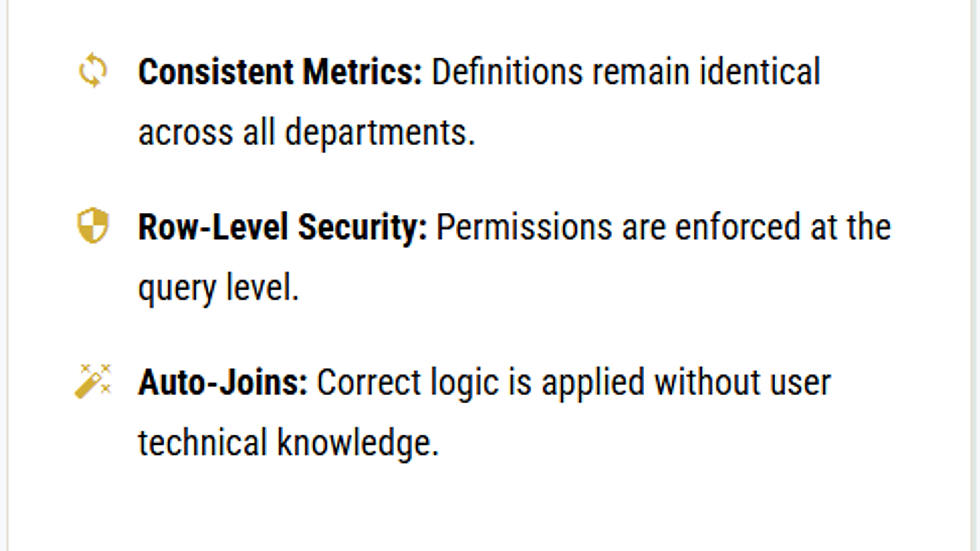
In Looker environments, every natural language query flows through the semantic layer. This ensures:
Consistent metric definitions across teams
Correct joins and filters applied automatically
Row-level security enforced at all times
Alignment with approved business logic
3. From Conversational BI to AI-Driven Analytics Workflows
Most organizations begin with conversational BI focused on simple questions such as revenue trends, performance comparisons, or daily summaries. Over time, usage expands into more advanced analytics workflows.
With AI-driven analytics in Looker:
Executives receive automated summaries
Teams perform multi-step root cause analysis through follow-up questions
Insights combine data across multiple enterprise systems
Analytics conversations appear inside collaboration tools like Slack or Microsoft Teams

This evolution is explored in more detail in our blog on AI-driven analytics in Looker and what it means for business users.
4. Empowering Teams Beyond IT Without Losing Governance
A common concern with self-service analytics is the loss of control. Conversational analytics addresses this by separating access from governance.
Sales teams analyze pipeline performance independently.
Finance teams validate trends, forecasts, and variances.
Marketing teams explore campaign performance and attribution.
Operations teams investigate anomalies in real-time.
IT and data teams retain ownership of the underlying models, ensuring that while the interface is conversational, the data remains a "single source of truth."
5. Why Conversational Analytics Delivers Immediate Business Impact
Organizations often see faster adoption of conversational analytics compared to traditional BI tools. The reason is simple. The interface aligns with how people already think and communicate.
The impact on technical teams is equally profound. A Forrester study revealed that Looker users experience a 99% reduced reliance on data teams for routine analytics requests.
Key benefits include:
Reduced dependency on analysts for routine questions
Faster executive response to changes and anomalies
Improved collaboration through shared definitions
More time for BI teams to focus on modeling and governance
These outcomes reinforce analytics as an everyday decision support system rather than a periodic reporting function.
6. Improving Cross-Team Collaboration with Conversational Analytics
Cross-functional teams often struggle with fragmented reporting. Conversational analytics establishes a shared analytical language. Marketing, sales, and operations teams receive answers based on the same semantic definitions. Context is preserved across follow-up questions, reducing misalignment and delays during critical decision cycles.
7. Measuring the Value of Conversational Analytics for Business Users
Organizations evaluate the success of conversational analytics using clear business metrics:
Reduction in analyst-driven requests
Faster time to insight
Increased adoption across departments
Improved confidence in reported numbers
Shorter reporting and decision cycles
Major League Baseball, for example, saw a 60% increase in data usage among marketing teams after democratizing access.
These indicators reflect a shift from static dashboards to analytics that actively support how teams operate day to day.

8. Implementing Conversational Analytics with SquareShift
Enabling conversational analytics requires more than turning on a feature. It depends on clean data models, strong governance, and tuning based on real business questions.
SquareShift helps organizations implement conversational analytics in Looker through structured programs focused on adoption, trust, and measurable outcomes. This includes semantic modeling, agent configuration, governance alignment, and enterprise deployment support.
Explore SquareShift’s conversational analytics services and see how your team can start seeing value within 3–4 weeks.
9. Conclusion
Conversational analytics for business users represents a fundamental shift in how organizations use data. Teams move from navigating dashboards to asking questions naturally and receiving accurate, governed answers in real time.
Built on Looker’s semantic layer and powered by cloud scale, conversational analytics enables faster decisions, stronger collaboration, and broader adoption without sacrificing control. As organizations look to empower teams beyond IT, conversational analytics is becoming the standard interface for business intelligence.
FAQs
What is conversational analytics and why is it important for business users?
Conversational analytics allows business users to ask questions in plain language and get accurate, governed answers instantly, making data analysis faster, easier, and more accessible across teams. It helps organizations democratize data, enabling employees to make informed decisions without needing technical expertise or complex dashboards.
How does Looker enable conversational analytics for teams?
Looker uses its Semantic Layer to connect natural language queries to approved business logic, ensuring consistent metrics, correct filters, and secure access for all users. This approach guarantees accuracy, reduces errors, and allows business teams to trust insights derived from multiple enterprise systems quickly.
Can non-technical teams use conversational analytics without IT support?
Yes, conversational analytics empowers Sales, Marketing, Finance, and Operations teams to explore data independently while IT retains control over governance and data models. Teams can ask follow-up questions, drill into metrics, and analyze trends instantly, accelerating decision-making across the organization.
What kind of business impact can conversational analytics deliver?
Organizations can reduce reliance on data teams, speed up insights, improve collaboration, and enable faster, confident decisions during meetings and operational reviews. It also increases adoption of analytics tools, enhances productivity, and allows employees to focus on higher-value tasks rather than routine reporting.
How does conversational analytics improve cross-team collaboration?
Yes, conversational analytics remembers context and builds on previous questions naturally.
By providing consistent metrics and preserving context across follow-up questions, conversational analytics ensures all departments work with the same data, reducing errors and delays. Teams can align goals, share insights easily, and make data-driven decisions collaboratively without miscommunication or conflicting reports.
How can my organization implement conversational analytics successfully?
Successful implementation requires clean data models, strong governance, and adoption support. Providers like SquareShift help deploy Looker conversational analytics with measurable results in weeks. Organizations benefit from structured programs that focus on training, semantic modeling, and ongoing tuning for maximum ROI and team engagement.


Comments