
MVC shapes modern software, particularly in web and mobile development. It organizes code and simplifies management. It also supports collaboration, scalability, and user experience.
MVC Origins
Computer scientist Trygve Reenskaug introduced MVC in the 1970s for desktop software. As web and mobile applications became more complex, MVC's separation of responsibilities became essential. Today, MVC supports core libraries such as Ruby on Rails, ASP.NET, and Django.
MVC Enables Specialized Team Roles
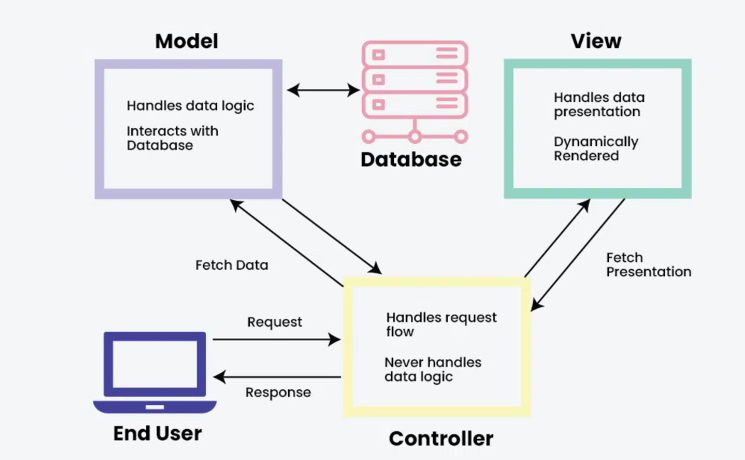
MVC separates application logic into distinct components. This structure allows team members to work in parallel on specific layers. Clear boundaries reduce conflict and increase parallelism:
- Backend developers manage the Model. They ensure data accuracy and security.
- Frontend developers build the View. They design layouts, forms, and user interfaces.
- Full-stack developers or product managers control the Controller. They manage data flow between Model and View to meet user requirements.
This structure enables faster development cycles. Teams can release updates without modifying the entire system. MVC also reduces code overlap. Separated components simplify error detection and resolution.
MVC Architecture
MVC Impact on User Experience
MVC improves user experience (UX) indirectly. The Model manages data. The View optimizes the user interface (UI). This separation provides:
- Faster loading times. The View handles display logic. Changes load dynamically. The full page does not reload.
- Error Reduction: The Controller validates user actions before the Model processes them. This structure limits unexpected errors that disrupt the user experience.
- Responsive Updates: MVC modular design supports real-time UI updates. This capability suits interactive applications, such as social media or messaging platforms, that require immediate user feedback.
MVC enables developers to build stable, fast, and reliable applications. This architecture supports user engagement and satisfaction.
When to Use MVC
- Best Fit: Complex applications that require scalability, including enterprise systems and applications with multiple user interfaces.
- Simple or small-scale applications. The added complexity is unnecessary.
MVC and Scalability: Design for Growth
MVC supports growth. It handles changing user needs and technology. An app can add complex features later. It does not disturb the original structure.
- Add features easily. The Controller manages Model and View interactions. You can implement new features independently.
- Flexible design. You can redesign the View. You do not change the underlying data. This helps you meet new design or accessibility standards.
- Modular components. View, Model, and Controller operate independently. Update or replace components without affecting others. Example: switching database types impacts only the Model.
This modularity supports scalable application development. It reduces the need for extensive code rewrites during growth.
Analogies for the Model-View-Controller Framework
The following analogies clarify MVC structure:
1. Restaurant Operations
Consider a restaurant. Customers (Users) interact with waiters (Controllers). Waiters place orders with the kitchen (Model). The kitchen prepares the food (Data). Waiters deliver the food to customers (View). The kitchen does not interact directly with customers. It prepares ordered items. Waiters handle delivery.
2. Online Shopping Assistant
In an e-commerce site, the Controller acts as a shopping assistant. It receives a customer request (product search). It fetches data from the Model (product details). It updates the View (webpage display). The user sees the final result. The user does not see the underlying data complexity.
MVC Frameworks: Practical Implementation in Software Development
Programming languages implement MVC frameworks. The following list shows common examples:
- Ruby on Rails: A Ruby web framework that prioritizes simplicity and efficiency. Common in startup environments.
- ASP.NET MVC: A Microsoft framework for the .NET platform. Supports scalable web applications.
- Spring MVC: A Java framework for large-scale enterprise solutions.
- Django: A Python framework for rapid development. Suited for content-heavy websites.
These frameworks provide a base for scalable, maintainable applications. Developers focus on unique features and user experience.
MVC Advantages
Separation of Concerns
Enables Parallel Development
Teams build components concurrently. Designers manage Views. Developers manage Models and Controllers.
Improves Maintainability
Changes to the user interface do not change data handling logic. Changes to data handling logic do not change the user interface. This separation reduces the impact of modifications.
Reusability
One Model serves multiple Views. This structure reduces code duplication.
Multi-Platform Support
One Model and Controller layer serves multiple frontends. These include web, mobile, and desktop applications.
Testability
Decoupled components enable easier unit testing, especially for Models and Controllers.
- MVC separates application logic (Model), user interface (View), and control flow (Controller). This separation enables independent management, testing, and scaling of each component.
MVC Disadvantages
Complexity
High Barrier to Entry
Developers new to the MVC pattern face implementation challenges. Strict framework adherence complicates the process.
Longer Development Time
Creating and maintaining multiple layers (Model, View, Controller) extends the development timeline. This contrasts with simpler architectures.
Controller Complexity
Poor design causes controllers to accumulate logic. This increases maintenance effort.
Debugging Complexity
Tracing data flow between components proves difficult in large MVC applications.
Processing Overhead
Multiple layers add processing time. High-speed applications may see reduced performance.
- The separation of components adds complexity to simple applications. This architecture suits large-scale projects better than small-scale ones.