

This series examines backend development beyond Node.js. It covers modern frameworks: Deno, Bun, and Cloudflare Workers.
This article details Deno, a runtime that solves Node.js limitations. Deno prioritizes security, supports native TypeScript, and simplifies tooling. It suits teams building secure, scalable, and reliable applications. The article covers Deno strengths and use cases. It shows how Deno fits projects ranging from simple tools to high-performance systems.

Deno: A Secure Runtime for JavaScript and TypeScript
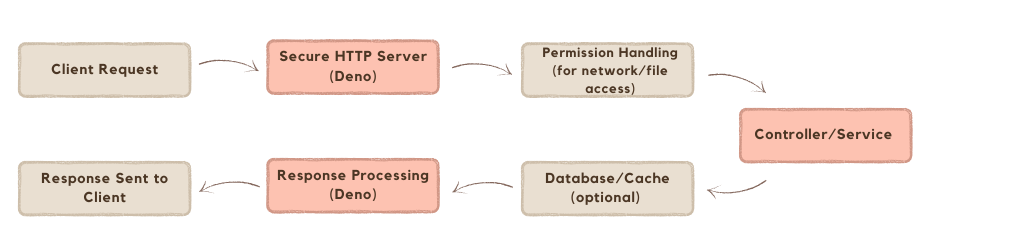
Deno, created by Ryan Dahl (founder of Node.js), addresses Node.js limitations through security, TypeScript support, and simplified workflows. Deno uses a default-deny permission model. It requires explicit grants for file system access, network requests, and environment variables. This design suits security-sensitive applications. Deno follows modern JavaScript standards. It reduces reliance on external libraries.
Key Features
- Security-First Design: Built-in permissions provide granular control over resource access. This enhances security in environments that handle sensitive data.
- Native TypeScript Support: Deno executes TypeScript without compilation. This speeds up development and enables runtime error checking.
- Integrated Tooling: Deno includes a dependency inspector, formatter, test runner, and bundler. These tools simplify setup and reduce reliance on third-party software.
- ES Modules and Standard Compliance: Deno supports ES modules and URL imports. This aligns with current JavaScript standards and increases dependency flexibility.
Performance Metrics and Benchmarks
Deno delivers strong performance in areas that require security and runtime efficiency:
- Cold Start Performance: Deno starts faster than standard Node.js applications. This reduces latency for event-driven and distributed apps. This capability supports serverless and edge computing environments.
- Memory Efficiency: The streamlined Deno runtime reduces overhead. This structure suits lightweight microservices and low-resource environments.
- File I/O Operations: Deno uses a non-blocking I/O model. This model handles asynchronous requests efficiently. It supports high-throughput systems such as data-intensive APIs and microservices.

DenoJS | NodeJS
serve
Use Cases
- Secure APIs and Microservices: Deno enforces a strict permission model. This model controls access between services. It suits fintech and healthtech applications that require high data integrity. Deno supports native TypeScript. This support reduces runtime errors and increases code safety. A fintech startup can use Deno to isolate service permissions. This ensures each service accesses only necessary resources. TypeScript use reduces errors and shortens development cycles.
- Edge computing. Deno fits edge workloads due to security controls and efficient resource use. It runs code near users with low latency. This improves performance for distributed systems. Example. A content delivery network can use Deno at the edge. This allows secure, isolated execution for global users. It processes regional requests quickly with low resource use.
- Simple web applications for startups. Deno benefits small and mid-size projects. It provides core tools without extra packages. This lowers complexity. Teams focus on core features. Example. A startup building a social platform may choose Deno. Its security model limits resource access. It supports TypeScript. This provides a stable base with less development work.
Summary
Deno combines security, speed, and modern JavaScript standards. It suits applications where security and code reliability are key. Its steady growth shows its value. It offers a reliable, TypeScript-ready runtime. It serves as a secure option beyond standard Node.js environments.