
Node.js is a leading platform for building scalable, high-performance server-side applications. It uses JavaScript on the Chrome V8 engine. The non-blocking, event-driven architecture handles concurrent requests efficiently. This design suits real-time applications.
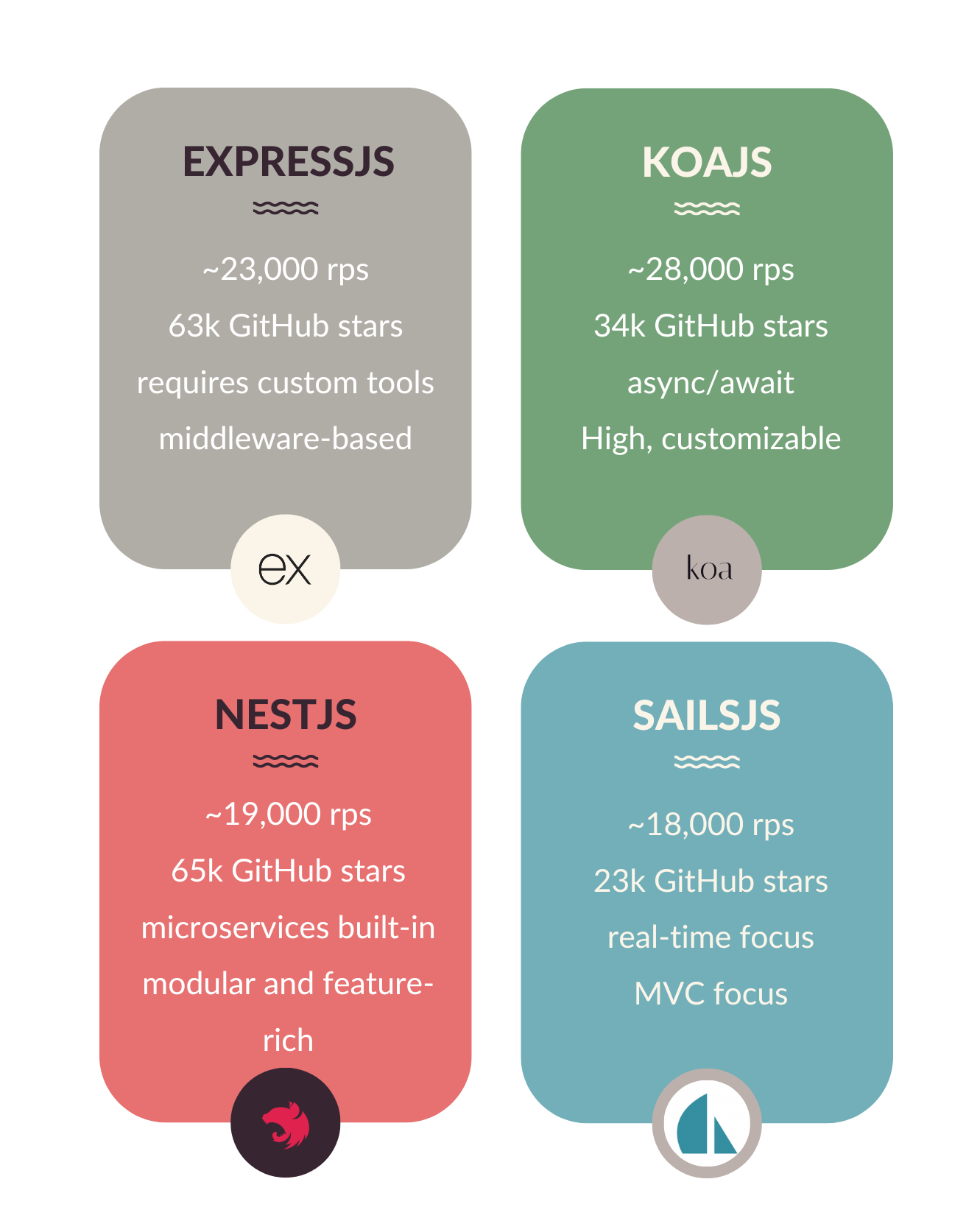
This article reviews four top Node.js frameworks: Express.js, Koa.js, NestJS, and Sails.js. Other frameworks may also meet your needs. Understanding their strengths and use cases helps you choose the right framework for your project.
1. Express.js: A Minimal Framework for API Development
Express.js is a lightweight, modular framework for web applications and APIs. It offers a minimal core and high flexibility, making it a standard for Node.js development.
- API Development
- Straightforward routing and middleware support RESTful APIs and microservices.
- Example: Uber uses Express for its API layer to serve millions of users.
- Single-Page Applications (SPAs)
- Express serves as the backend for SPAs, managing client-server data exchange.
- Example: MySpace uses Express to power its SPA architecture.
- Microservices
- Minimal overhead supports modular, scalable microservice architectures.
- Example: IBM Watson uses Express to manage microservices for specific AI tasks.
- Prototyping
- Simplicity supports rapid creation of Minimum Viable Products (MVPs) and working prototypes.
- Example: Accenture uses Express to build MVPs to test new service concepts.
Koa.js: Middleware Control for RESTful APIs
The Express team developed Koa.js. It uses modern JavaScript features and a middleware-driven architecture. This design provides developers with precise control and flexibility.
- Koa uses async/await for readable code and error handling. It handles asynchronous requests in RESTful APIs. Alibaba uses Koa for this purpose.
- Koa has a minimal core. It builds fast, efficient web applications. Parcel uses Koa for the backend of its build tool.
- Koa has no default configuration. Developers can build custom frameworks. Shopify used Koa to create internal tools.
- Middleware-Driven Applications: Koa’s middleware stacking system supports complex workflows. Example: Yelp uses Koa for data-intensive services.
3. NestJS: TypeScript Framework for Enterprise Applications
NestJS is a progressive framework built on TypeScript. It supports scalable and maintainable applications. The modular architecture and microservices support suit large-scale systems.
- Enterprise Applications: Nest’s modular design and TypeScript integration support maintainability in large-scale systems. Example: Adidas uses NestJS for scalable internal applications.
- Microservices: Nest supports built-in microservices for distributed architectures. Example: T-Mobile uses NestJS for scalable telecom microservices.
- GraphQL support: NestJS integrates with GraphQL libraries to handle flexible, query-based data interfaces. Example: Airtable uses NestJS to manage user-defined API schemas via GraphQL.
- Server-Side Rendering (SSR): NestJS pairs with SSR libraries to reduce page load times and improve search engine optimization for dynamic content. Example: Walmart uses NestJS with SSR to optimize its e-commerce platform.
Sails.js: MVC Framework for Real-Time Applications
Sails.js is an MVC framework for real-time applications and data-driven APIs. Use it for projects requiring multi-user interaction or immediate data updates.
- Real-Time Support: Sails.js includes native WebSocket support for chat platforms and live data feeds. Example: Trello uses Sails.js for real-time task management features.
- Multi-User Systems: Sails handles real-time user interactions effectively. Use Sails for dashboards or collaboration tools. Example: Coursera uses Sails for real-time communication between students and instructors.
- Data-Driven Applications: The Waterline ORM in Sails simplifies interaction with multiple databases. Sails supports CRUD-based applications. Example: Practo uses Sails to manage real-time healthcare data across various systems.
- Enterprise Web Apps: Sails supports real-time capabilities and multiple databases. Choose Sails for enterprise applications requiring real-time data synchronization. Example: Interactive Brokers uses Sails for real-time data updates in its trading platform.
Conclusion
Node.js provides a diverse ecosystem of frameworks for backend development.
- Express.js: Simplicity.
- Koa.js: Modern middleware control.
- NestJS: Scalability.
- Sails.js: Real-time capabilities.
Each framework has distinct advantages. Select the framework based on project requirements. Understanding strengths and use cases leads to informed choices. This approach builds efficient and scalable applications.
The next article examines backend JavaScript frameworks outside the Node.js ecosystem. It provides options for your development needs.