
Hallucinations in Large Language Models (LLMs) produce inaccurate data. RAG applications rely on accurate, grounded outputs. This guide details steps to evaluate RAG performance and limit hallucinations.
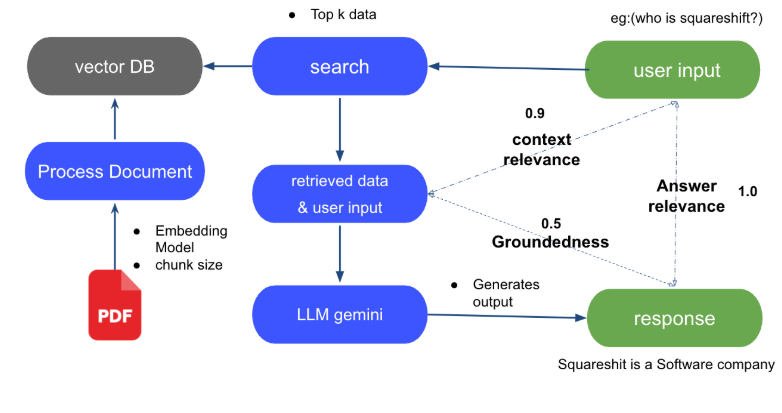
Definition of RAG
RAG executes three steps to generate factual answers:
- Retrieval: The system pulls relevant information from a vector database. This database stores processed documents as embeddings for fast search.
- Augmentation: The system combines the retrieved data with the user query to provide context.
- Generation: The LLM uses the augmented input to create a clear response.
The RAG Triad for Evaluation
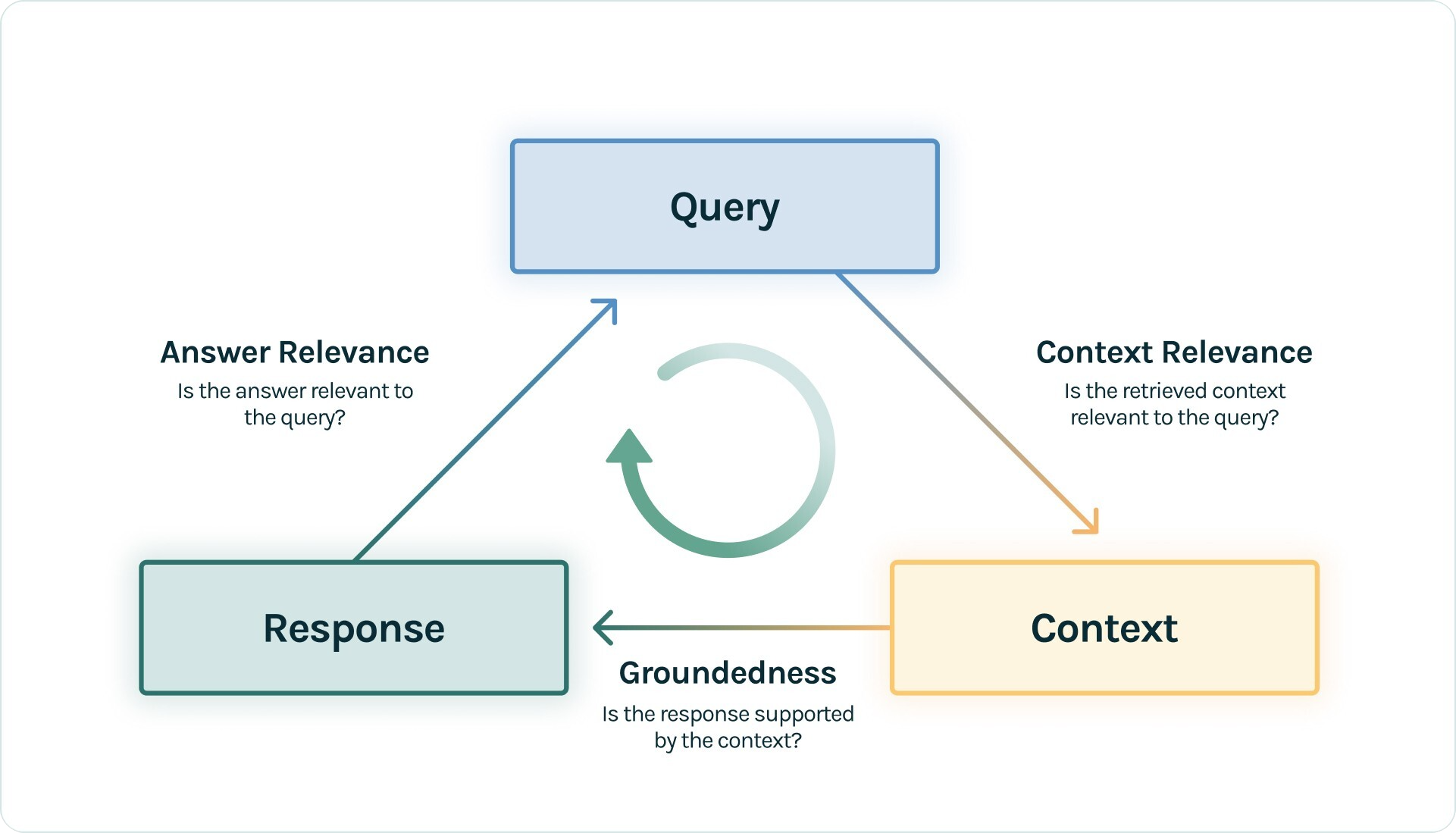
Evaluate the app against the RAG Triad: Context Relevance, Groundedness, and Answer Relevance. This process eliminates hallucinations.
1. Verify Context Relevance
- Irrelevant data introduces noise.
- Noise reduces response accuracy.
Ensure retrieved data aligns with the user query. Example: For the query "Who is SquareShift?", the app must retrieve specific SquareShift snippets. It must exclude data about other companies.
2. Measure Response Groundedness
- Fabricated claims reduce groundedness.
- Unsupported additions lower accuracy.
Verify the LLM response strictly uses retrieved data. Example: If data states "SquareShift specializes in workflow automation," the LLM must not add "cloud solutions" without basis. Deduct points for unsupported additions.
3. Assess Answer Relevance
Verify that the response answers the specific user query. A factually correct response must remain relevant to the prompt. For example, if a user asks, "Who is SquareShift?", the response "SquareShift is a software company that automates workflows" is relevant.
Importance of RAG Evaluation
Evaluating RAG applications confirms data accuracy and response grounding. This process reduces hallucinations and increases user trust.
Trends in LLM Evaluation
LLM evaluation practices evolve to improve reliability and accuracy.
- Feedback-Driven Iteration: Evaluation frameworks use user and system feedback loops to refine responses. This ensures LLMs adapt to specific use cases.
- Explainability Metrics: Tools track explainability. This allows developers to identify why an LLM generated a specific response.
- Multimodal Integration: LLMs support multimodal inputs, such as text, image, and video. Evaluation tools measure groundedness and relevance across these modalities.
- Real-Time Monitoring: Observability tools like Phoenix use real-time monitoring. This feature identifies and addresses hallucinations as they occur.
Tool Adoption of Emerging Evaluation Trends
- Ragas and TruLens integrate these trends into their frameworks. TruLens uses feedback functions to align LLM outputs with user expectations. Phoenix provides real-time insights to detect and mitigate hallucinations in production.
Conclusion
Focus on the RAG Triad: Context Relevance, Groundedness, and Answer Relevance. This improves RAG reliability. TruLens and Phoenix provide detailed LLM evaluation data. Use these tools to assess and improve application precision. They support feedback-driven iteration, explainability, and real-time monitoring. This ensures the system provides grounded and reliable responses.
The next section shows how TruLens improves evaluation clarity and actionability.