
Web applications require consistent data management. Dynamic interfaces increase complexity. Predictable state flow reduces errors. Flux and Redux implement unidirectional data flow. This pattern simplifies debugging and supports scalability.

Unidirectional Data Flow
Unidirectional data flow moves data in one direction. This structure provides a clear path from source to destination. The pattern simplifies tracking changes. It supports easier management of application state.
Unidirectional data flow works as follows:
- Data originates from a central source (state).
- Actions change state only through dispatched updates.
- UI components update when state changes. They do not modify data directly.
Unidirectional flow suits applications with complex state and frequent interactions, such as e-commerce sites or social media platforms. This pattern keeps the interface consistent.
Flux: The Original Unidirectional Data Flow Pattern
Facebook created Flux to manage data in JavaScript applications. The pattern enforces a single data flow. This prevents data distribution errors across components.
Key Components of Flux
Flux divides data flow into four parts:
- Actions: Payloads that move data from the application to the dispatcher. Example: A request to add an item to a cart.
- Dispatcher: Receives all actions and routes them to the target store. This central component directs actions to the correct destination.
- Stores: Hold application state and logic. Each store manages a specific state segment and updates itself upon receiving dispatched actions.
- View: Renders the application state. This UI component reflects changes made by the stores.
Flux data flow operates as a linear sequence. Actions trigger the dispatcher, which updates stores. Views then re-render with the updated state. This one-way flow removes dependencies between components and simplifies complex interactions.
The Role of Flux in Unidirectional Architecture
Flux resolves state inconsistency in large applications. It prevents concurrent updates by centralizing data changes through actions and stores. This ensures all updates follow a defined path.
Redux: Extending Flux with State Management Enhancements
Redux extends the Flux architecture. It streamlines development and improves state predictability. Created by Dan Abramov, Redux serves as a primary library for state management in frameworks such as React.
Redux Core Concepts
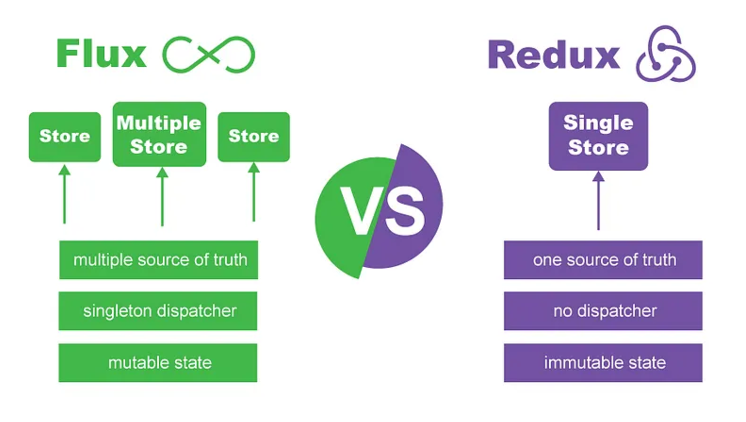
Redux uses a single store. This differs from the multi-store structure in Flux. Redux refines the pattern in the following ways:
- Actions – Actions define events. Each action object contains a type field and an optional payload.
- Reducers – Redux uses reducers instead of direct store updates. A reducer is a pure function. It takes the current state and an action. It returns a new state. This structure clarifies state changes.
- Store – Redux uses a single store for the entire application. The store holds the state. It serves as the single source of truth. All components read from this store.
Redux Data Flow Structure
Redux uses a deterministic data flow:
- The system dispatches an action to signal a change. For example, a button click adds an item to a cart.
- Reducers receive the current state and the action. They apply required changes and return a new state.
- The store updates with the new state. Components re-render with the new data.
The Redux store is the single source of truth. It keeps application state consistent across components. This design ensures predictable behavior and simplifies debugging.
Reasons for Redux Adoption
Redux offers essential state management for React and other front-end libraries. Its tools simplify debugging and scaling. The time-travel feature records every state change. Developers can trace these changes to locate bugs and observe state evolution. This structure supports complex applications.
Key Benefits of Flux and Redux
1. Predictability and Debugging
- Data flows in one direction. Tracking changes is straightforward. Redux time-travel debugging displays every change in the app. This feature improves bug detection and resolution.
2. Consistency
- Flux and Redux enforce a single path for state changes. This prevents components from modifying data directly. The app state remains consistent and reliable.
3. Separation of Concerns
- Flux and Redux separate data, state management, and UI components. This structure creates modular, reusable code that is easier to maintain.
When to Use Flux or Redux
Small applications with limited state rarely require Flux or Redux. Use these patterns for complex applications. Apply them when multiple components share state or when user interactions frequently update the UI.
Flux and Redux serve specific use cases:
- Large applications with complex UI and multiple data sources. For example, e-commerce apps must synchronize product, cart, and user data.
- Applications with real-time updates. Chat apps, dashboards, and financial tools that refresh frequently require a defined data flow.
- Single-page applications (SPAs). SPAs with dynamic interactions and frequent view changes need a consistent state management model.
Example: Unidirectional Data Flow
Example: Redux shopping cart.
- User Action: User selects “Add to Cart.”
- Dispatch Action: Action dispatches `{ type: 'ADD_TO_CART', payload: { productId: 1, quantity: 2 } }`.
- Reducer Process: Reducer adds product to the current cart state.
- Store Update: Store updates global state; application reflects the change.
- View Re-Renders – The UI updates to display the item in the cart.
This explicit flow ensures consistent state updates and accurate UI reflection for every user action. It prevents undefined behavior.
Conclusion: Value of Unidirectional Data Flow
Unidirectional data flow with Flux and Redux produces maintainable, scalable applications. Flux established the foundation. Redux optimizes complex state management, specifically within the React ecosystem.
Unidirectional data flow delivers consistency, predictability, and reliability. Flux and Redux simplify development and enhance user experience. These patterns remain essential for building efficient, maintainable applications as complexity increases.
Future Trends
1. Simplified State Management
- New libraries: Alternatives such as Recoil, Zustand, and XState provide simpler and more efficient state management, reducing Flux and Redux complexity.
- GraphQL integration: Tools like Apollo Client combine Flux/Redux with GraphQL to manage server and client state seamlessly.
2. Server-Side and Client-Side Integration
- React Query and Next.js connect client and server state. They simplify Flux and Redux integration in server-side rendering (SSR) environments.
3. Improved DevTools
- Advanced Debugging
- Enhanced tools will support time-travel debugging.
- State tracking will improve for Flux and Redux applications.
4. Performance Focus
- Future Flux and Redux implementations will target:
- Optimized state updates.
- Reduced boilerplate.
- Scalable application performance.