
Large Language Models (LLMs) change application development. They support chatbots and content generation. This guide covers practical steps to build LLM applications. It lists key factors for successful implementation.

1. Define the Use Case
Identify a clear use case to use LLMs. Ask:
- Define the specific problem the application addresses.
- Identify the end user and define the interaction model.
Example: In a travel booking app, an LLM can generate itineraries, suggest rebookings, or answer visa questions.
2. Select the appropriate LLM.
Select an LLM that meets application requirements. Open-source models like LLaMA or Falcon support customization. Proprietary models like GPT or Gemini provide advanced capabilities.
Evaluate the following factors:
- Model size and latency requirements
- Budget constraints
- Pre-training on domain-specific data
3. Data Preparation and Fine-Tuning
Generic LLMs provide broad capability. Fine-tuning with domain-specific data increases accuracy. A fine-tuned model produces responses that match user intent. Use LangChain or Hugging Face for fine-tuning and embedding workflows.
4. Application Development
Integrate the LLM using APIs or libraries. Key components include:
- Backend: Use Django, Flask, or FastAPI to deploy the application.
- Frontend: Design a user interface that is intuitive and supports the LLM interaction.
- Middleware: Add monitoring and logging to track model performance.
5. Ethical and Performance Standards
Building ethical applications requires adherence to specific standards:
- Bias and Fairness: Continuously evaluate outputs for bias and correct errors.
- Transparency: Inform users when they interact with AI.
- Data Privacy: Follow laws, such as GDPR, to protect user data.
6. Test and Optimize the System
- Test the application for accuracy, scale, and speed.
- Use user feedback to improve the model.
- This process helps developers use LLMs well.
- It also solves ethical and operational problems.
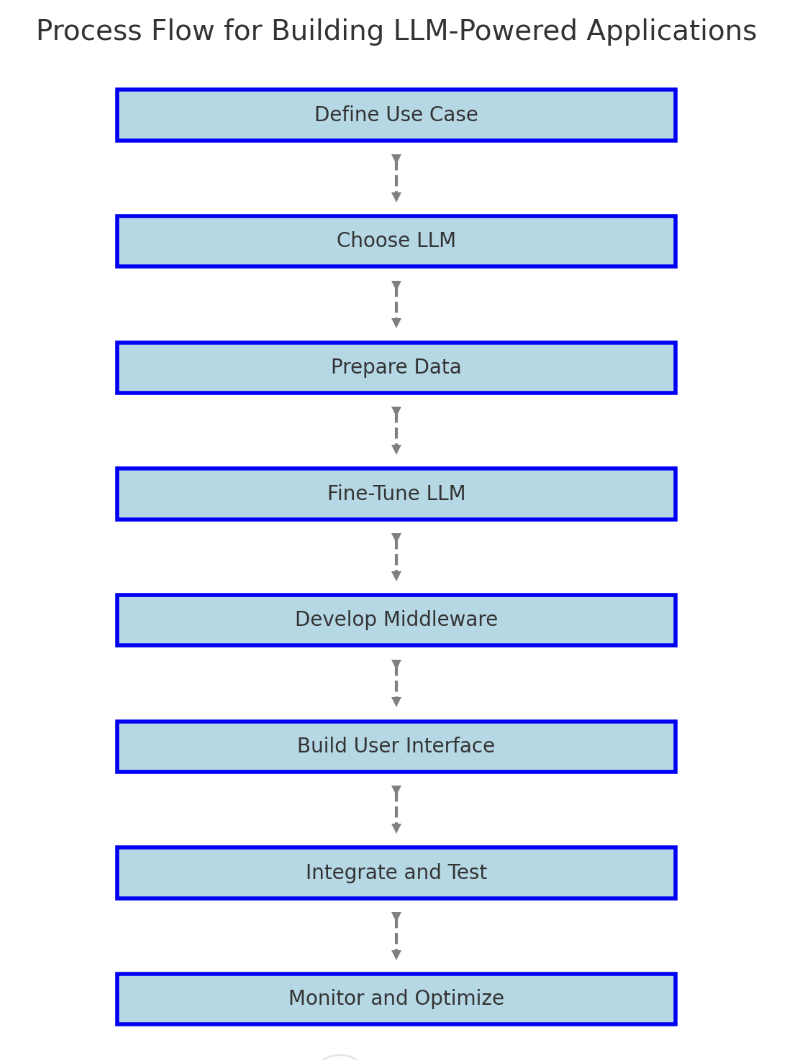
Process Flow to Build LLM Applications:
Case Study: LLM-Enabled Travel Application
We developed a proof of concept for a travel app supporting flight and hotel bookings. Using Vertex AI Agent Builder with the gemini-1.5-flash model, the app interpreted user preferences, suggested layover activities, and recommended hotels.
We selected Gemini for its strong natural language understanding and high-accuracy handling of complex queries, which suits travel planning. Agent Builder, a managed GCP service, simplified deployment and scaling. This approach delivered a reliable and efficient application. We built this proof of concept as a generative AI application.
Conclusion
Building LLM-powered applications combines innovation with user-centric design. This process requires attention to ethical standards, including data privacy, fairness, and accountability.
The next article, "Ethical Considerations in LLM Development and Deployment," covers the construction of responsible and trustworthy AI systems. Continue to the next section for details.