
SquareShift Technologies Inc
AI Travel Assistant for Travel Management
10/03/2024
AI Travel Agent Overview
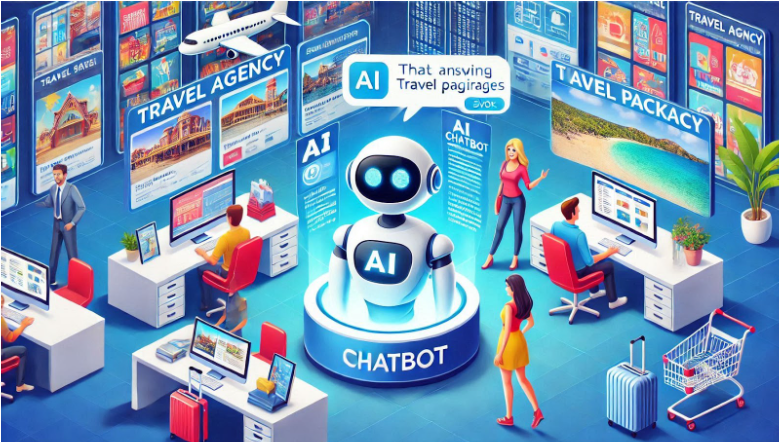
This whitepaper details the design, architecture, and implementation of an AI Travel Agent system using Google Vertex AI Agent Builder. The system provides real-time, personalized travel planning. Key functions include flight and hotel booking, visa query handling, and layover recommendations via natural conversation. The document defines the business question, solution design, and implementation strategy.
Problem Statement
Travelers struggle to plan trips efficiently due to fragmented systems and limited personalized support. This AI Travel Agent system addresses these issues by providing:
- Real-Time Assistance: Access to current flight, hotel, and visa data.
- Personalization. Recommendations match user preferences and behavior.
- Ease of use. A natural language interface handles queries intuitively.
The business goal is to streamline travel planning and improve user experience using advanced AI capabilities.
Machine Learning Use Case for an AI Travel Agent
The AI Travel Agent uses generative AI and machine learning to:
- Process natural language queries. The agent parses input, retains conversation context, and returns accurate responses.
- Generate personalized recommendations. The agent analyzes user preferences and behavior to suggest relevant flights, hotels, and activities.
- Ingest real-time data. The agent uses APIs to retrieve current flight, accommodation, and event data.
Architecture Overview
Google Vertex AI Agent Builder powers this integrated solution. The system streamlines travel planning. It supports conversational interfaces and delivers real-time, API-driven recommendations.
Core Capabilities
- Natural Language Interface: Process flight, hotel, and visa queries through direct text interaction.
- Real-Time Data: Integrate Google SERP and Serper APIs to provide current flight schedules, hotel offers, and local activities.
- Contextual Retention: Track conversation history to deliver personalized suggestions.
- Scalability: Host on Google Cloud Functions to optimize performance and resource usage.
Solution Design
Architecture Overview
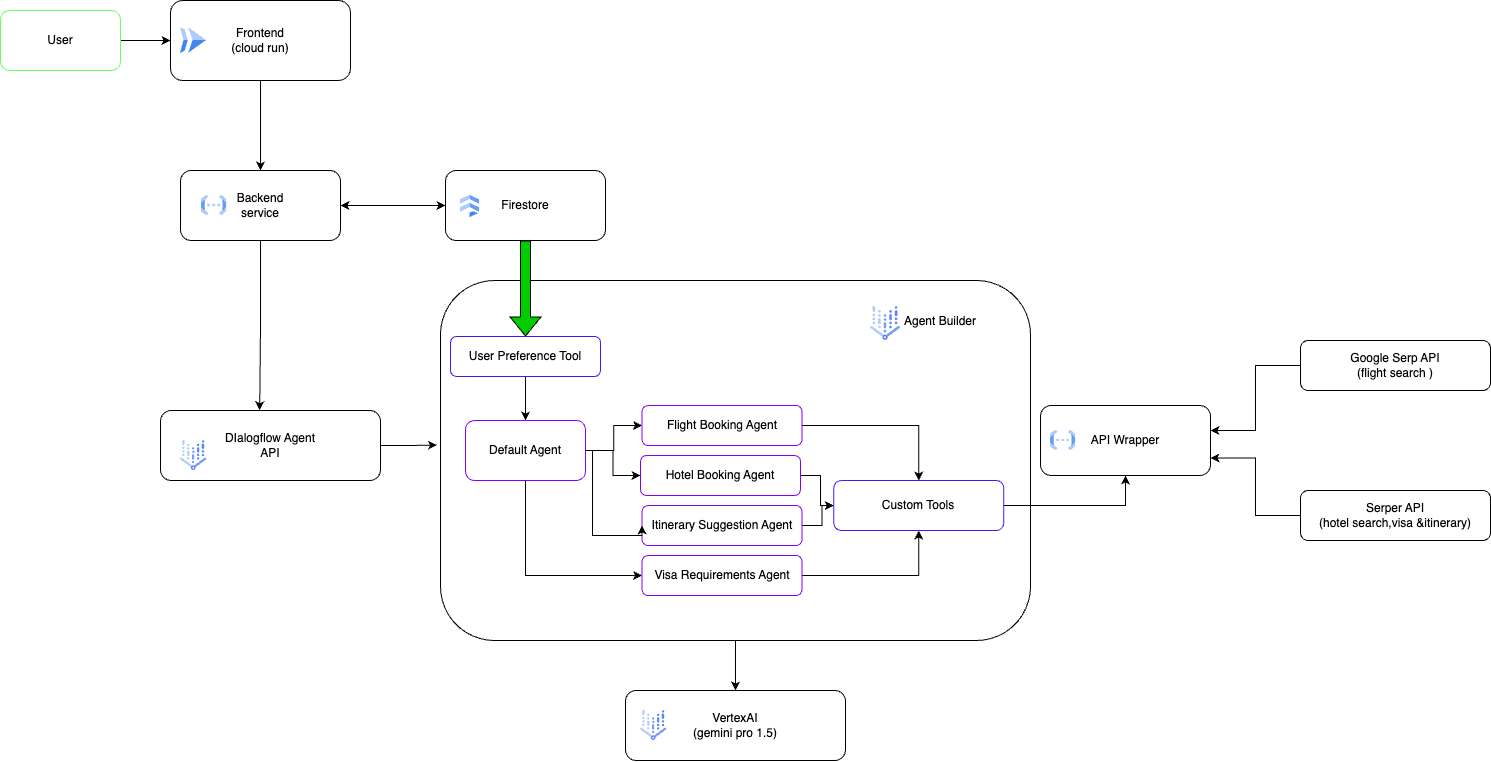
The solution uses these components:
- Frontend: Interface for chatbots and Google Maps integration.
- Backend: Google Cloud services: - Vertex AI Agent Builder: Manages agent logic and conversation flows. - Firestore: Stores user preferences and history. - Google Cloud Functions: Supports scalable, serverless deployment.
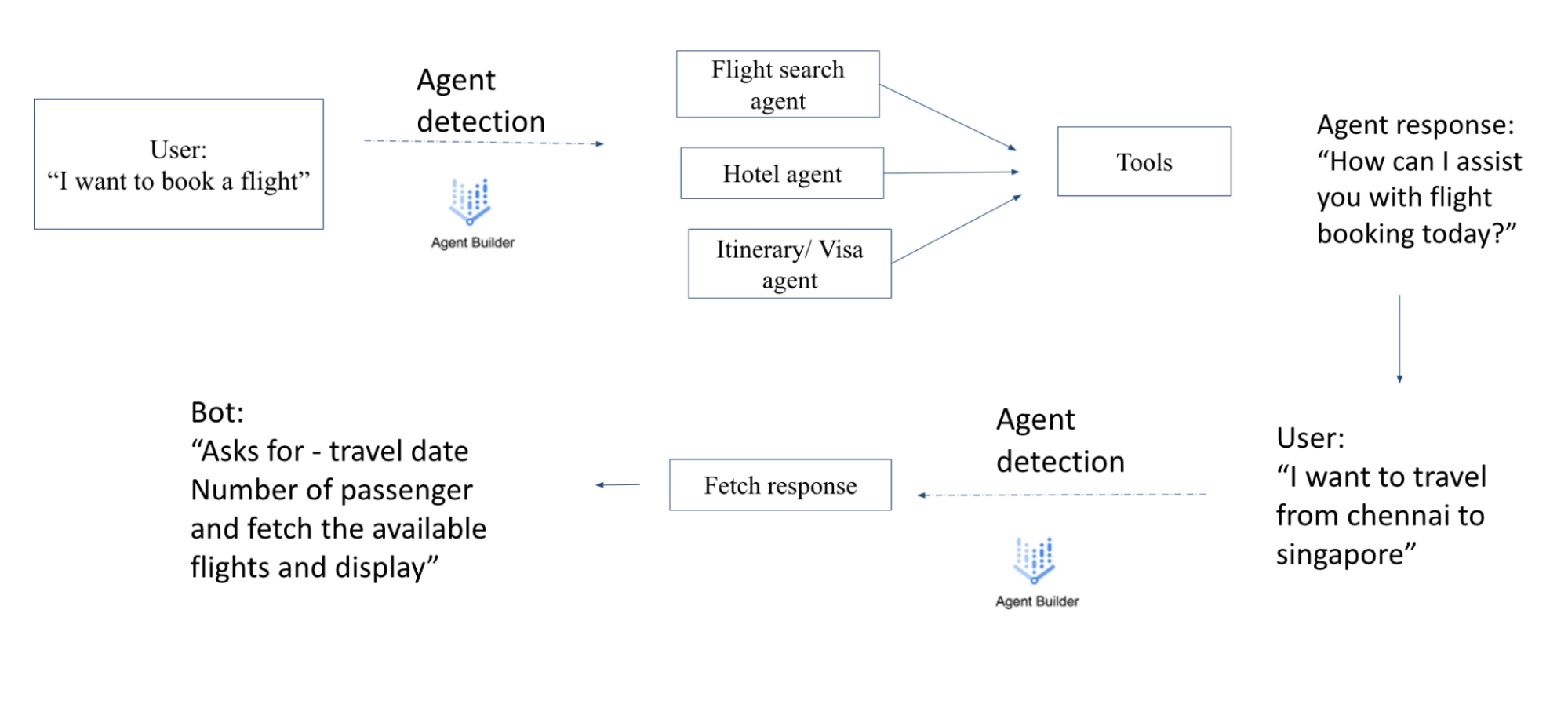
Workflow Example
| Use Case | User Input | Agent Response |
|---|---|---|
| Flight Booking | "I want to book a flight to New York." | Asks for travel dates and preferences, then fetches tailored options using SERP API. |
| Hotel Booking | "Find me a hotel near Times Square." | Returns personalized hotel recommendations via Serper API. |
| Layover Activities | "What can I do during my 6-hour JFK layover?" | Suggests nearby attractions or activities based on layover duration. |
| Visa Requirements | "Do I need a visa for Singapore?" | Provides up-to-date visa information using Serper API. |
Exploratory Data Analysis (EDA)
We performed Exploratory Data Analysis (EDA) on travel datasets to ensure the AI-powered Travel Agent provides accurate recommendations.
Key focus areas:
- Flight frequencies
- Popular routes
- Passenger preferences
This analysis established baseline trends and patterns in travel behavior. These findings directly informed system design and feature prioritization.
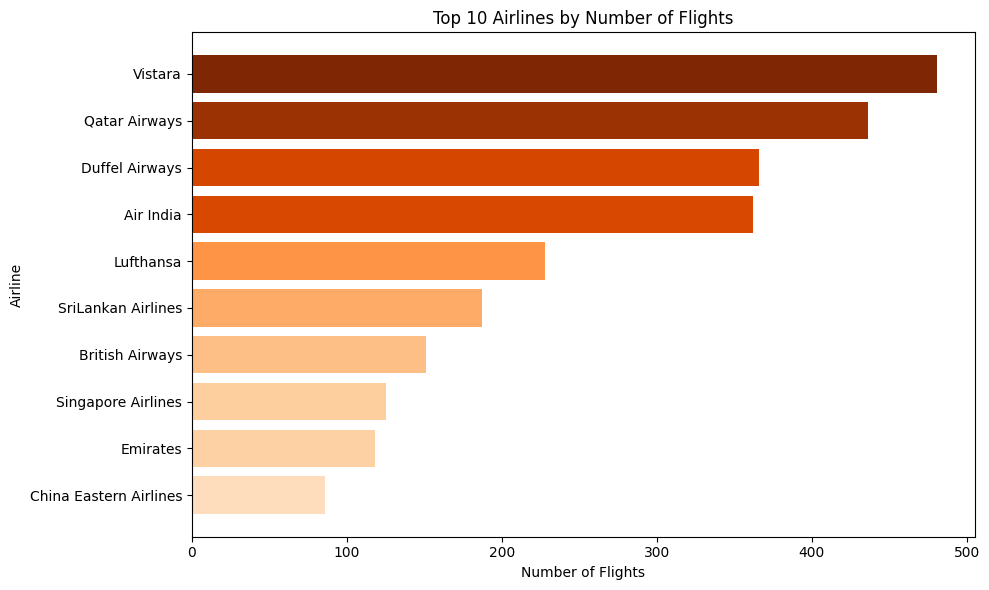
Top 10 Airlines by Flight Count
We identified airlines with the highest flight counts to determine market leaders.
Process:
- Grouped the flight dataset by airline
- Aggregated flight counts per carrier
- Generated a bar chart for the top 10 airlines
These results highlighted carrier dominance and frequency. This data guided the prioritization of airline-specific API integrations. Prioritizing top carriers ensures the system delivers real-time, relevant updates for high-traffic routes.
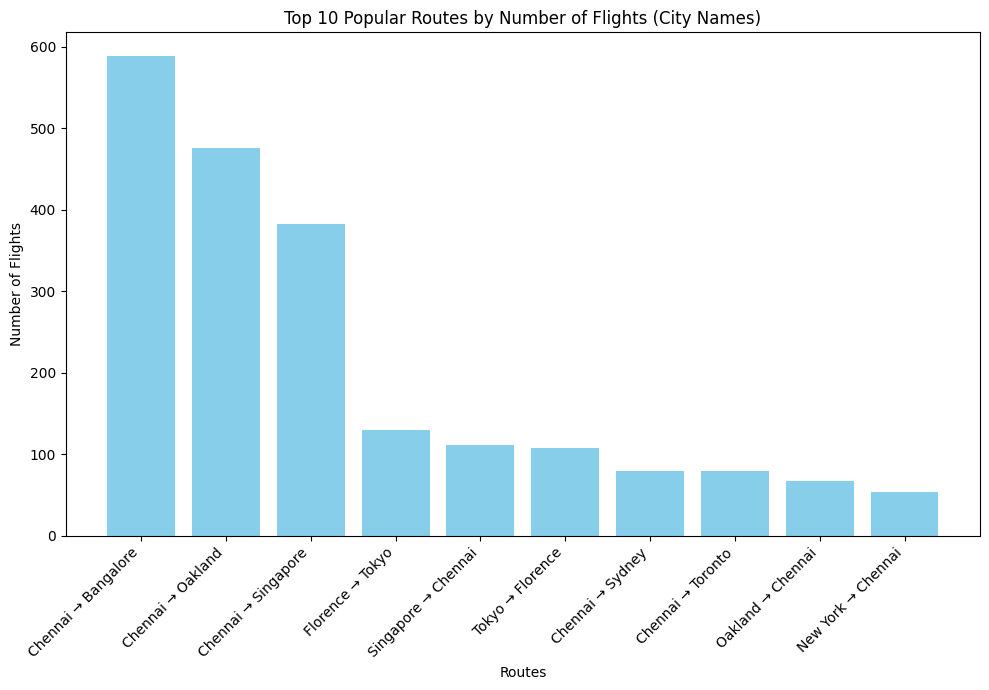
Top 10 Routes by Flight Frequency
Analyze city pairings with the highest flight frequency. The process groups data by origin and destination, then sorts by count. This identifies high-traffic routes. The system uses this data to pre-fetch information. This action reduces response times. It also improves the user experience. The data supports layover activity recommendations. It also aids connection planning on high-demand routes.
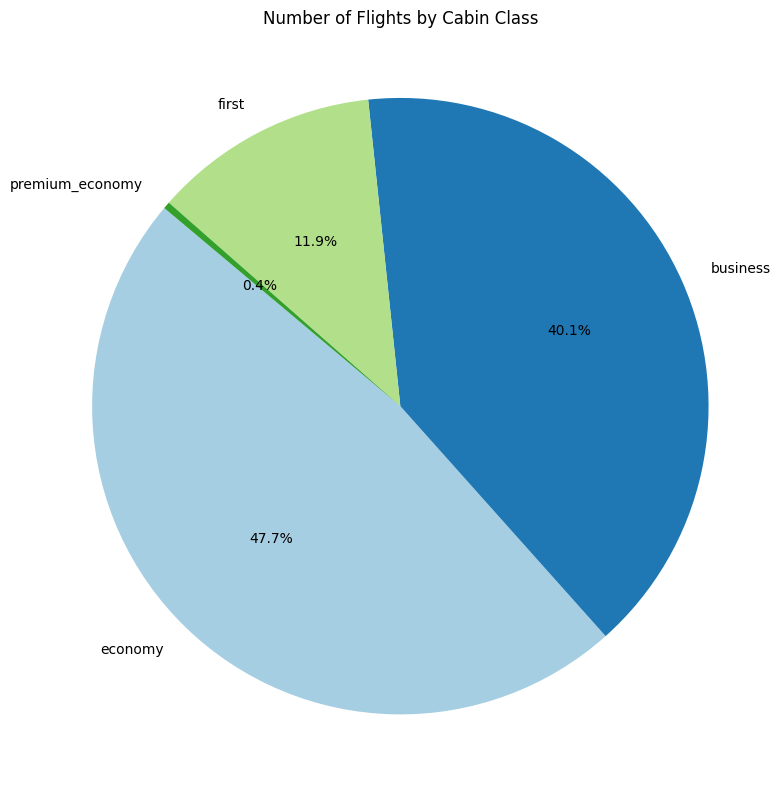
Flight Volume by Cabin Class
Analyze flight volume by cabin class. The dataset categorizes flights into Economy, Business, and First Class. A pie chart visualizes the distribution of passenger behavior. These insights guide recommendation logic. The system suggests premium options for business travelers. It offers budget options for economy travelers.
Model Selection
Gemini 1.0 Pro serves as the foundation for the AI Travel Agent. Selection criteria include:
- Advanced language capabilities
- High performance and safety
- Contextual understanding and intent detection
Gemini 1.0 Pro handles complex travel queries. It generates personalized planning responses. Integration with Vertex AI Agent Builder simplifies deployment and scaling. The model supports high interaction volumes with low latency. It minimizes risks of inaccurate or harmful outputs. This combination enables an AI Travel Agent that provides:
- Personalized recommendations
- Real-time insights
- An intuitive conversational interface
Model Development
Model Development uses Vertex AI Agent Builder and Gemini 1.0 Pro. The process includes:
- Defining agent purpose for travel planning
- Designing conversation flows for intent detection
- Integrating Gemini 1.0 Pro for complex queries
The agent trains on diverse dialogue data. It connects to external APIs for real-time flight, hotel, and visa data. This architecture ensures accurate and personalized travel recommendations.
Define Agent Purpose, Scope, and Design Playbook
The AI Travel Agent assists with travel itinerary planning. Scope includes:
- Flight bookings
- Hotel reservations
- Visa requirements
- Local attraction recommendations
The agent provides personalized recommendations based on user preferences and history. It supports multi-leg trip bookings. It does not process financial transactions. The agent behavior follows a Vertex AI Agent Builder playbook. The conversation flow detects user intents and extracts key details. Integration with Gemini 1.0 Pro enables:
- Understanding of complex queries
- Maintenance of conversational context
- Delivery of personalized responses based on user input and historical data
External API Integration Pipeline
The agent connects to two external APIs to retrieve real-time travel data: Google SERP and Serper. Google SERP provides flight schedules, prices, and layover details. Serper provides hotel suggestions, visa requirements, and local activity recommendations. The agent accesses these services through OpenAPI tools using the provided schema.
The agent uses user preferences stored in Firestore, such as travel class, seat location, and cabin selection.
External APIs
- Google SERP: Retrieves flight schedules, prices, and layover details.
- Serper: Provides hotel options, visa rules, and local activity recommendations.
Data transformation and preprocessing pipeline
The Vertex AI agent requires input data to match the format required by the travel booking APIs. The system uses a transformation and preprocessing pipeline to convert raw user text into structured data with standard values. For example, the pipeline converts airport names to airport codes. This process ensures the data meets the specific requirements of the target APIs.
Incorporate Examples in Playbooks
Examples guide the AI travel agent by showing specific user interactions. They help the model identify user intent and respond correctly. In the Vertex AI Agent Builder, you add examples to the playbook by defining sample dialogues for various scenarios. These examples cover simple tasks, such as booking flights or hotels, and complex tasks, such as searching for activities or visa requirements. This approach improves the agent’s ability to extract relevant information. It also helps the underlying machine learning model handle diverse user queries accurately and efficiently.
Deployment Architecture
The system runs on Google Cloud Functions. This serverless infrastructure scales automatically with user demand. It reduces infrastructure management and lowers costs during low-traffic periods.
A CI/CD pipeline supports rapid updates. Automated testing and monitoring ensure system reliability. Google Cloud Load Balancing distributes traffic efficiently. Monitoring tools provide actionable insights for system health and performance.
Google IAM policies, encryption, and API gateways protect user data and interactions. This architecture provides scalability, security, and cost efficiency. It supports the dynamic requirements of the AI system.
Solution Benefits
Improve User Experience
- Deliver fast responses through a seamless conversational interface.
- Provide personalized recommendations for flights, hotels, and activities.
Access Real-Time and Dynamic Data
- Integrate APIs to provide real-time flight and hotel updates.
- Delivers dynamic visa and activity recommendations.
Scalability and Cost Efficiency
- Deploys as a serverless application using Google Cloud Functions.
- Scales with user demand. Keeps costs low.
Future-Ready Architecture
- Modular architecture supports features such as car rentals, weather updates, and trip analytics.
- The system expands to integrate third-party services and broaden the travel ecosystem.
Summary
The AI-powered Travel Agent solution combines generative AI with real-time data integrations to improve travel planning. It uses Vertex AI Agent Builder to provide personalized, scalable, and dynamic assistance for travelers. This approach enables next-generation digital travel solutions.
SquareShift designs and builds AI agent workflows like this travel agent, from agent playbooks to serverless deployment.
To see more agent builds, read about LangGraph multi-agent systems and a healthcare appointment scheduling agent with Vertex AI Agent Builder.
Resources
- https://cloud.google.com/generative-ai-app-builder/docs/introduction
- https://cloud.google.com/dialogflow/cx/docs/concept/playbook
- https://cloud.google.com/dialogflow/cx/docs/quick/build-agent-playbook
- https://serpapi.com/google-flights-api