
Retrieval-Augmented Generation (RAG) systems combine information retrieval and text generation. Evaluating these systems ensures accurate and relevant responses. This article details evaluation techniques and practical applications.
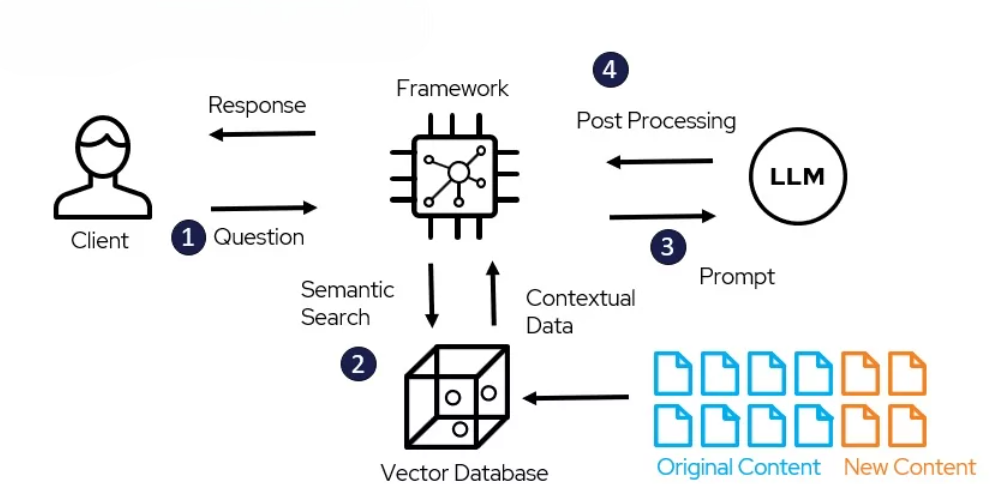
RAG System Architecture
RAG systems retrieve relevant documents from a knowledge base. The system then generates responses based on this content. Effective evaluation requires verifying that retrieval and generation components function correctly together.
1. TRIAD Framework
The TRIAD framework evaluates Retrieval-Augmented Generation (RAG) systems. It assesses three components: Context Relevance, Faithfulness, and Answer Relevance.
Context Relevance
Consider a RAG system for medical inquiries. A user asks about medication side effects. The system retrieves documents. Context relevance measures how many retrieved documents address the query.
If the system retrieves five documents but only two address medication side effects, precision is low. Evaluators use Precision and Recall to quantify this metric. If 70 of 100 retrieved documents are relevant, precision is 0.7 (70%).
Controlling these metrics prevents the context window from filling with irrelevant documents. This preserves token capacity for essential input.
Faithfulness (Groundedness)
Example: A user queries climate change impacts on polar bears. The RAG system retrieves relevant articles but generates a response stating polar bears are thriving due to tourism. This claim lacks support in the retrieved documents.
Faithfulness evaluation checks if the generated response aligns with retrieved documents. Use human evaluation or automated fact-checking tools. High groundedness requires the response to match source content.
Answer Relevance
Example: A user asks, "What are the benefits of meditation?" If the RAG system includes irrelevant information about yoga, it fails the answer relevance criterion.
Automated methods reduce the manual effort required for human evaluation. These methods include embedding-based similarity measures. The system calculates cosine similarity between generated responses and reference answers. This approach uses vector representations to scale the evaluation process.
2. eRAG Evaluation Approach
This method evaluates the retriever model within the RAG system.
The eRAG method evaluates individual documents retrieved for a specific query during generation.
Example: A user asks about recent advancements in renewable energy technology. The RAG system retrieves 10 articles but uses only 3 to generate an answer. eRAG assesses how well each document contributes to an accurate response.
Developers generate LLM outputs for each document independently. They evaluate these outputs using downstream task metrics, such as accuracy. This process identifies documents that improve response quality. This method correlates better with actual performance than end-to-end evaluations.
Example:
Query: "Who discovered penicillin?"
The retrieval model returns a ranked list of documents:
- Document 1: “Alexander Fleming discovered penicillin in 1928.”
- Document 2: “Penicillin was a breakthrough antibiotic...”,
- Document 3: “Marie Curie won the Nobel Prize...”
Traditional methods evaluate the retriever using cosine similarity or LLMs. These metrics often show poor correlation with real-world performance. eRAG evaluates the downstream performance of the full RAG system against each retrieved document. This process assigns a real-world performance score to each document. These scores define document relevance.
Run this evaluation once. Each query then has a relevance score for every document. This output forms the dataset.
This dataset measures the retriever model's ability to return only relevant documents.
3. Human-in-the-Loop Evaluation
Human feedback improves the assessment of RAG system performance.
Spot Checks
Example: A tech support chatbot uses a RAG system to provide solutions from retrieved manuals and forums. Subject Matter Experts (SMEs) review random interactions to verify solution accuracy and utility.
Use this qualitative feedback to guide model training and refinement. This ensures the system meets user needs.
Online Experimentation
Consider an e-commerce platform using a RAG system for product queries. Conduct A/B testing to compare an older system version against an updated version. Measure user satisfaction and engagement metrics for both groups.
Higher satisfaction rates or longer engagement times for the updated version indicate improved performance over previous iterations.
4. Domain-Specific RAG Techniques
Core Elements of Domain-Specific RAG Evaluation
Evaluate domain-specific RAG systems using these key components:
Rubric-Based Metrics
Scenario-Specific Datasets
Use domain-specific datasets for accurate evaluation. The RAGEval framework creates these datasets via a multi-stage process: schema summarization, document generation, question-reference-answer creation, keypoint extraction, and metric assessment. This method captures the unique characteristics of the target domain.
- Rubrics. Structured scoring systems that define criteria for each level, typically 1 to 5. These guides assess output relevance and accuracy for domain-specific questions. A custom rubric may score answers based on alignment with ground truth or question relevance 1.
- Reference-Based and Reference-Free Methods. Evaluations use reference-based methods to compare outputs with known correct answers. Reference-free methods assess quality without direct comparison. Both methods provide a full view of model performance.
Evaluation Metrics
Retrieval Metrics
Precision and Recall. These metrics measure how well a RAG system retrieves relevant documents.
Example: A legal AI retrieves 50 documents for a contract law query. If 20 are relevant, precision is 0.4. This metric quantifies retrieval accuracy.
Response Metrics
BLEU and ROUGE compare generated text to reference texts. These metrics measure quality but lack context awareness.
- BLEU measures precision. It counts how many words in the generated output match the reference text.
- ROUGE-N, including ROUGE-1 and ROUGE-2, measures recall. It counts how many reference words appear in the generated summary.
These metrics measure surface similarity. They do not capture semantic meaning. Embedding-based methods address this gap. Compare sentence embeddings from BERT or Sentence-BERT. Use cosine similarity or other distance metrics. This assesses contextual relevance more effectively.
Advanced Techniques
Re-ranking techniques improve retrieval performance. They enhance context understanding.
Example: Retrieve initial results for a query about travel destinations. Re-ranking prioritizes documents. It selects recent or comprehensive information. It aligns with user preferences or past interactions.
Embedding models improve retrieval accuracy. They capture semantic relationships. They outperform traditional keyword-based methods.
Conclusion
- Evaluate Retrieval-Augmented Generation systems using quantitative metrics, qualitative assessments, and human feedback.
- Apply frameworks like TRIAD and eRAG to measure retrieval effectiveness and response quality.
- Refine system performance continuously based on evaluation data.
- Optimize accuracy to meet user needs in complex digital environments.
These methods help teams deliver generative AI solutions that give accurate, relevant answers.
Related guides: evaluating agentic architecture systems and building LLM-powered applications.