
Migrating workloads from AWS to Google Cloud Platform (GCP) enables the use of TensorFlow and the PaLM 2 model. This article defines the architecture design for this transition. It details the implementation of the Askbot application to increase platform availability, reliability, and cost-efficiency.
Background
LexRes is migrating Askbot applications from AWS to GCP. The organization uses GCP services, including TensorFlow and PaLM 2. This migration aims to improve user experience, reduce costs, and maintain operational reliability.
Problem Statement
Migrate Askbot from AWS to GCP. Deploy TensorFlow and PaLM 2. Optimize availability, performance, and cost. Improve chat response quality using advanced AI capabilities.
Requirements
General Requirements
- Data Migration Strategy: Define a plan for data transfer. Specify data types and sizes.
- Application Compatibility: Verify AWS-to-GCP interoperability.
- Security & Compliance: Meet regulatory requirements.
- Cost Optimization: Reduce operational spend.
- Scalability: Adjust capacity to demand.
- Disaster Recovery: Establish resilient recovery procedures.
- Monitoring tools: Track performance.
- User training: Provide guidance and documentation.
- Vendor support: Define service level agreements with GCP.
Technical requirements
- Performance: Optimize load and response times.
- Availability & Reliability: Minimize downtime.
- Security: Apply encryption and access controls.
- Maintainability: Simplify updates and troubleshooting.
- Usability: Design clear interfaces.
- Compliance: Meet industry standards.
System Function
Administrator Capabilities
Administrators upload and manage case files. These files use CRUD operations. This data feeds TensorFlow and PaLM 2. These models generate Askbot responses.
User Capabilities
Users query Askbot for case information. TensorFlow and PaLM 2 provide relevant responses.
Solution Architecture
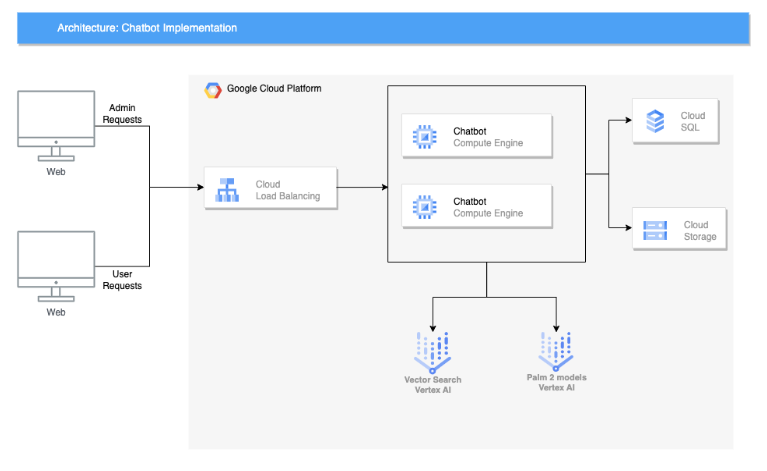
This architecture integrates Google Cloud Platform services. The design supports robust, scalable, and efficient platform operations.
System Components
- Cloud Load Balancing distributes user and admin API requests across Compute Engine instances. It uses a global anycast IP address to optimize latency and traffic flow. [Placeholder: Diagram illustrating Cloud Load Balancing with GCP. Alt text: Diagram showing how Cloud Load Balancing works in GCP.]
- Google Cloud Storage (GCS) serves as the primary data repository. Documents and case files migrate from Amazon S3 to GCS.
- Deploy Compute Engine Askbot within a Virtual Private Cloud (VPC) to isolate resources. Configure load balancing to maintain availability and performance.
- Cloud SQL: Store metadata in a relational database to support scalable and highly available operations.
- TensorFlow and PaLM 2 for Retrieval and ResponsesTensorFlow and the PaLM 2 model drive retrieval and content generation.
- TensorFlow handles data processing and model training.
- PaLM 2 generates contextually relevant responses.
This integration reduces inference time and improves scalability.
Security Controls
- Encrypt data at rest using Customer Managed Encryption Keys (CMK).
- Data in Transit
- Encrypt data using HTTPS.
- IAM
- Enforce fine-grained role-based access control.
- Network Security
- Host resources in VPCs.
- Restrict external access.
[Placeholder: Diagram of security layers in the architecture. Alt text: Illustration of layered security measures in GCP.]
Monitor and Optimize the System
- Performance Monitoring: Generate alerts for metric deviations.
- Cost Management: Apply billing exports, sustained use discounts, and real-time cost tracking.
Next Steps
Optimize efficiency and costs with LexRes on GCP. Contact our team to start your migration and improve operations.
SquareShift offers AI implementation services, including moves of AI applications like Askbot from AWS to Google Cloud.
For newer Google models, read our guide to Gemini 2.0 Flash in Google AI Studio and our best practices for agent apps on Vertex AI.
Conclusion
This plan migrates workloads to Google Cloud Platform (GCP). The system uses TensorFlow and the PaLM 2 model. These actions improve user experience, security, scalability, and cost efficiency.