

Introduction
Project Background: The Fork
Licensing and Governance: Structural Differences
Feature Sets and Ecosystems: Diverging Roadmaps
Total Cost of Ownership (TCO) Analysis
Use Cases and Organizational Fit
Conclusion: Strategic Implications
Next Steps
Elasticsearch and OpenSearch drive search and analytics infrastructure. These projects compete for market share. This split stems from a licensing change. Each platform now has distinct features and goals. Enterprises must choose based on cost, strategy, and capability. This decision affects long-term operations.
This article compares Elasticsearch and OpenSearch. It details core differences, features, and performance. It also covers practical implications. Use this data to select the best platform for your organization.
The main difference is licensing: OpenSearch uses Apache 2.0, while Elasticsearch uses SSPL, ELv2 and AGPLv3.
Why OpenSearch Forked from Elasticsearch: The Licensing Fork

The split began in 2021. Elasticsearch used the Apache 2.0 license for years. This license allowed free use and distribution. Cloud providers like AWS built managed services on this base. The license change triggered the OpenSearch fork.
Elastic changed the licensing policy for Elasticsearch to protect its business model. From version 7.11, Elasticsearch and Kibana use the Server Side Public License (SSPL) and Elastic License 2.0 (ELv2). These licenses are not OSI-approved open source. They limit how third parties can distribute the software as a service.
AWS and its partners forked the final Apache 2.0 versions of Elasticsearch (7.10.2) and Kibana (7.10.2). They named the new community project OpenSearch. This move confirmed a commitment to a genuinely open-source alternative. The two projects now follow distinct development paths.
Licensing and Governance: Core Philosophical Differences
Licensing and governance distinguish OpenSearch from Elasticsearch. This difference reflects their core philosophies, not just legal terms.
OpenSearch: Strict Open-Source Compliance
OpenSearch remains a fully open-source project. It uses the Apache 2.0 license. This license is widely adopted. You can use, modify, distribute, and sell OpenSearch. You face no legal uncertainty.
The OpenSearch Project governs the codebase. Major industry players support the project, including AWS, SAP, and Logz.io. In late 2024, the project joined the Linux Foundation. This move ensures long-term open governance. It also supports community contributions. This structure suits organizations with strict open-source policies. It reduces vendor lock-in risk. Project control does not rely on one firm's commercial interests.
Elasticsearch Licensing Structure
Elasticsearch uses a hybrid licensing model. Core features use the SSPL and ELv2 licenses. These are not OSI-approved open-source licenses. You can inspect the source code. Most internal use cases do not face restrictions. Building a managed service requires a commercial agreement with Elastic.
Elastic added the GNU Affero General Public License (AGPLv3) as a third option. This applies to free code components. AGPLv3 is an OSI-approved license. It includes strong copyleft terms. If you modify AGPLv3 code and sell the service, you must share the source code. This move balances community engagement with commercial protection. It safeguards the Elastic Cloud service.
Legal and CTO teams should assess licensing first. If your policy requires OSI-approved licenses, select OpenSearch.
Feature Sets and Ecosystems: Diverging Development Paths
Both projects innovate along different paths. The feature gap is narrowing. Ecosystem differences are distinct.
OpenSearch: Community-Driven Platform
OpenSearch prioritizes mirroring and extending previous open-source Elasticsearch capabilities. The project provides open-source versions of features previously available only in Elastic’s proprietary X-Pack.
Key OpenSearch features and ecosystem components include:
OpenSearch Dashboards: The Kibana fork for visualization. It provides an interface for data exploration and management.
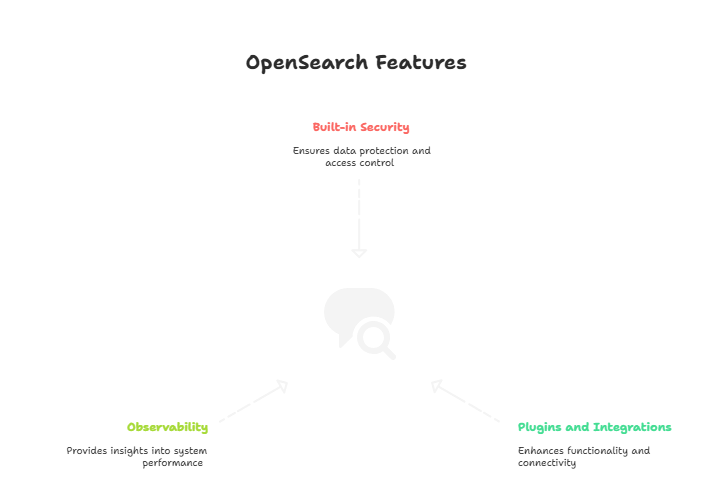
Built-in Security: OpenSearch includes a comprehensive, open-source security suite by default. This suite provides fine-grained access control, role-based security, and encryption in transit. It removes the need for commercial security plugins.
Plugins and Integrations: The plugin ecosystem is maturing. AWS offers integrations with Amazon S3, Kinesis, and Lambda. This suits organizations with significant AWS investments. The platform includes a dedicated vector search engine. It supports AI and machine learning applications.
Observability: OpenSearch provides features for log analytics, performance monitoring, and tracing. It supports monitoring of distributed applications.
Elasticsearch: Commercial Platform Capabilities
Elasticsearch, part of the Elastic Stack, functions as a commercial platform. The stack comprises Elasticsearch, Logstash, and Kibana. Elastic integrates these components into a single product. Advanced features are restricted to paid subscription tiers.
Key Elasticsearch features include:
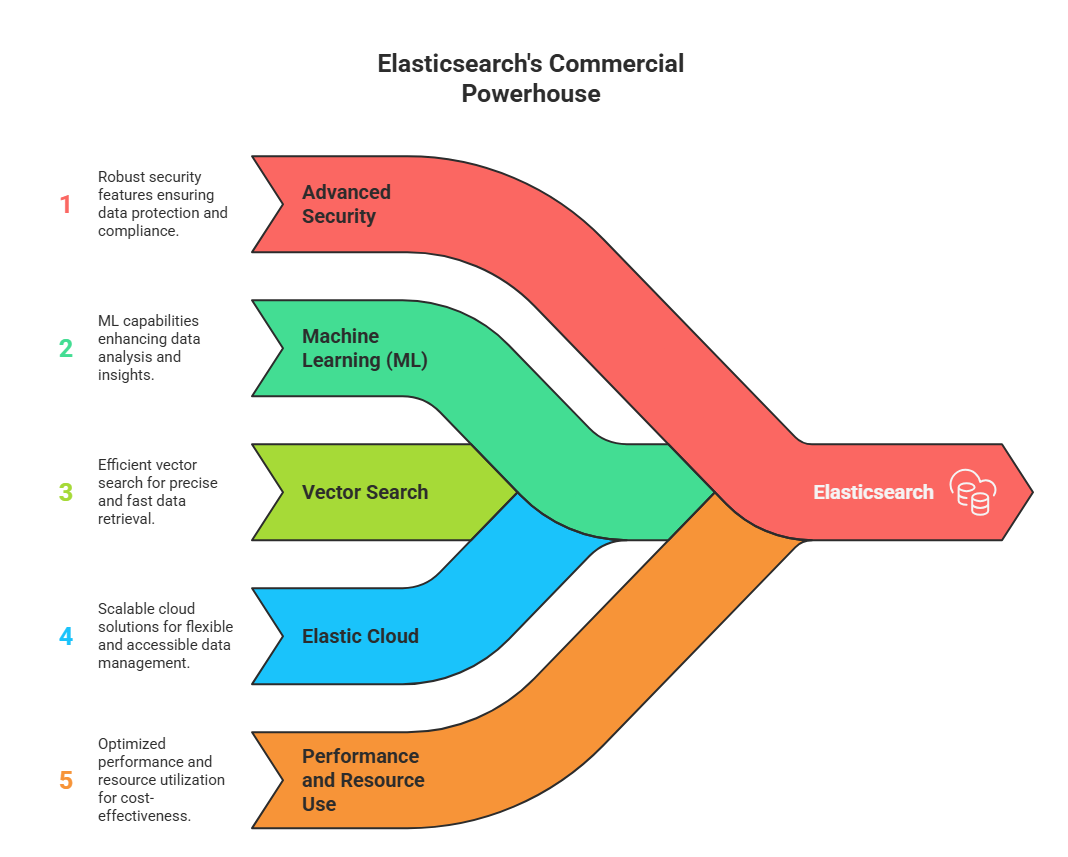
Security: Free plans provide basic security. Paid plans offer single sign-on, field-level security, and audit logging.
Machine Learning: Elastic includes proprietary machine learning tools. These tools detect anomalies and forecast data. They serve security analytics and observability needs without external integrations.
Vector search performance differs. Elastic invests in Apache Lucene optimizations shared by both projects. Elasticsearch often provides faster results for AI-driven search.
Elastic Cloud simplifies operations. The managed service handles scaling, upgrades, and maintenance. It suits teams that prefer a low-maintenance solution.
Performance and Resource Usage: Data Shows Key Differences
Performance often drives platform selection. Both platforms use Apache Lucene. Different development paths create distinct performance characteristics.
Independent tests from 2024–2025 show Elasticsearch often outperforms OpenSearch. In complex text queries and sorting, Elasticsearch runs 40% to 140% faster. It also uses resources more efficiently.
Elastic attributes this performance edge to focused optimization of its core code and proprietary Lucene improvements. For applications requiring low latency or where resource efficiency drives significant cost reduction, this advantage can be decisive.
OpenSearch vs Elasticsearch Total Cost of Ownership (TCO)

Beyond technical capabilities, Total Cost of Ownership (TCO) is a primary concern for business leaders. Licensing models directly influence this cost.
OpenSearch TCO is typically stable and lower. All features, including robust security, are open source, eliminating licensing fees. Primary costs are infrastructure (cloud or on-prem) and cluster maintenance. When using Amazon OpenSearch Service, costs are usage-based. You can select instance types and pricing models to manage spend.
Elasticsearch TCO is more complex. While the core is open source, advanced features (e.g., machine learning, enhanced security) and official support require payment. These costs are substantial at high scale. For organizations needing proprietary features, these costs may be justified by the added value and reduced operational complexity of a fully supported solution.
The decision follows a build-versus-buy logic.
- OpenSearch: You build the solution. You host open-source components or use a third party.
- Elasticsearch: You buy a commercial platform. It offers integrated features and managed support.
Use Cases and Audience: Who Is Each Platform For?
Select based on specific use cases and organizational priorities.
OpenSearch Suits Organizations That:
- Have strict open-source requirements: Policy or philosophy mandates the use of OSI-approved licenses.
AWS-centric organizations. Firms with deep AWS commitments use Amazon OpenSearch Service to leverage native integrations and a managed operational model.
Elasticsearch suits:
Enterprises requiring advanced native features. Organizations needing built-in machine learning for security or observability select Elastic to access these capabilities without custom development, accepting the associated licensing costs.
Performance-critical environments. Companies where query latency and resource efficiency determine operational success prioritize Elasticsearch's query execution engine.
Teams seeking managed operations. Organizations delegate cluster maintenance to Elastic Cloud. This approach frees engineering staff to focus on product development.
End-to-end, single-platform businesses: Organizations requiring integrated Elastic Stack components (Elasticsearch, Kibana, Beats, Logstash) and unified vendor support.
Conclusion: A Strategic Decision Beyond Technical Metrics
The OpenSearch versus Elasticsearch comparison extends beyond licensing forks. It reflects organizational priorities regarding cost, flexibility, performance, and long-term strategy.
For organizations prioritizing open source, community collaboration, and vendor independence, OpenSearch provides a viable path. It maintains core platform capabilities under a permissive license with a growing feature set.
Elasticsearch and Elastic Cloud remain strong options for businesses requiring commercial support, advanced machine learning, and a single-vendor model.
Select the platform that aligns with your team's skills, project requirements, and strategic data infrastructure goals.
If you plan to move between the two platforms, see our Elasticsearch migration services.
Compare Your Options
Selecting a search and analytics engine requires technical assessment. If you need guidance on your approach, contact our team. We will review your use case and provide a recommendation to support your data infrastructure goals.
Related reading: Elasticsearch, Solr, OpenSearch and Coveo compared and Elastic vs Weaviate for AI search.