


Online retail remains highly competitive. You have built a high-quality website, created compelling product pages, and executed external marketing campaigns. However, customer success begins on your homepage. The internal search bar is your most valuable tool. It is not only a navigation feature; it reveals customer intent.
Internal search is a core component of your e-commerce platform. It helps users locate products. Effective search reduces bounce rates and accelerates purchase decisions. For leadership teams, internal search is a business requirement, not a technical feature. It directly impacts revenue, customer satisfaction, and brand loyalty. This article explains why internal search is a primary sales channel. It provides actionable steps to maximize its performance.
In short: internal search captures customer intent, and the Baymard Institute reports that site searchers convert 2-3 times more often than non-searchers.
Review enterprise case studies on e-commerce search implementation.
Ecommerce Site Search: A Strategic Conversion Asset
The site search bar captures specific customer intent. Users who type queries express a clear desire to purchase. They do not browse; they communicate need. The Baymard Institute reports that site searchers convert 2-3 times more often than non-searchers. This data confirms that internal search is a strategic business priority, not a peripheral feature.
A properly optimized internal search engine provides three key advantages:
Higher Conversion Rates
Matching customers with correct products removes friction from the purchase path. For example, a search for “men's waterproof hiking boots” must yield highly relevant results. This direct alignment shortens the path to conversion.
Higher Average Order Value (AOV)
Search engines display relevant products and complementary items. This supports upsells and cross-sells, which increases purchase size.
Customer Insights
Search queries provide data on customer intent. Analyzing these queries reveals product demand and inventory gaps. Use this data to optimize merchandising, marketing, and product development.
Improved Customer Experience (CX)
Reliable search builds trust. Users who find products quickly return more often. This pattern drives customer retention.
Most internal search engines underperform. Baymard research shows many e-commerce sites fail to handle typos, synonyms, or valid queries with no results. These failures frustrate users and reduce revenue.
Components of an Intelligent E-commerce Search Engine
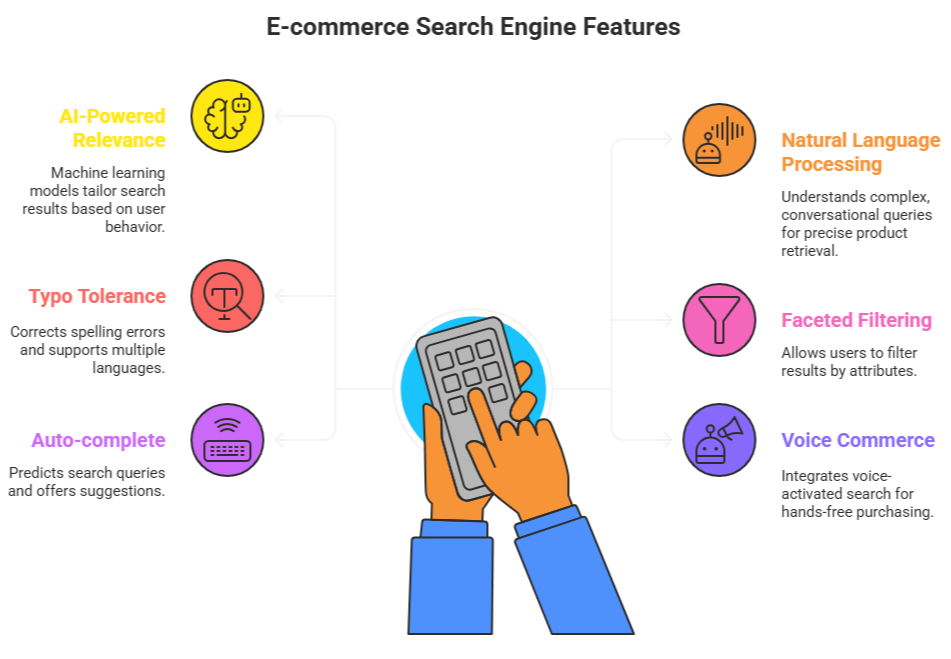
A high-performance e-commerce search engine operates beyond keyword matching. It uses context to predict user intent and delivers relevant results. This section outlines the core components of an effective internal search system.

1. Core Functionality: Relevance and Speed
Core functions:
- Return useful results.
- Present results quickly.
A one-second delay causes user abandonment.
Synonym and Typo Tolerance:
- Map synonyms: "sneakers," "trainers," and "running shoes."
- Correct frequent misspellings.
- Return results for corrected terms (e.g., "Bose headphones").
Natural Language Processing (NLP):
- Process full sentences and phrases.
- Return relevant results for complex queries.
- Remove the need to break down questions (e.g., "a pair of red shoes for a wedding").
Structured Data and Faceted Search:
- Present structured results for general queries (e.g., "laptops").
- Provide robust filters (facets).
- Filter by attributes: brand, price, screen size, processor.
- Enable rapid option narrowing.
2. User Experience: Reduce Search Friction
Effective search engines operate naturally and invisibly. They guide the user without requiring conscious effort.
Instant Search and Autocomplete:
The search box must suggest products, categories, and popular queries as the user types. This reduces time to completion and directs the user to high-converting keywords.
Zero Results Page Optimization:
When a search returns no results, a robust e-commerce search engine must prevent a dead end. It should recommend similar products, link to related categories, or prompt the user to refine the query. This approach converts a failure into a productive interaction.
Visual search
Growth in mobile commerce and AI drives the adoption of visual search. The search engine must allow users to capture an image of a product and identify similar items in the database.
E-commerce trends: Personalization, AI, and the future of search
The intranet search landscape changes rapidly due to advances in artificial intelligence and machine learning. CTOs and management teams must monitor current trends to maintain competitiveness.
1. AI-Driven Personalization: Context-Aware Search
Next-generation search engines will use machine learning to process user history, purchase data, and demographics. These systems will deliver highly personalized results.
Application:
A user who frequently buys Nike running shoes types "running shoes." The search engine prioritizes the latest Nike models and related items. This approach increases conversion rates. Personalization ensures the user receives relevant options.
2. Voice Search Integration: Conversational Interface
Voice search adoption has increased with the proliferation of smart speakers and mobile assistants. Prepare your e-commerce site to process natural, full-phrase queries.
Your search engine must process natural, conversational queries. For example: "display the top-rated coffee machines under $100." This requires advanced language and context comprehension.
3. Centralize All Content: Beyond Product Search
Modern internal search engines extend beyond product listings. They index all site content, including blogs, FAQs, help centers, and store locations. This transforms the search bar into a comprehensive customer service tool.
How to Optimize Ecommerce Site Search: Strategies
Optimize internal search to increase revenue. Management should execute the following actions.
1. Perform Search Audit
Analyze current search data. Identify top queries, zero-result terms, and drop-off points. Use analytics tools to measure performance. Locate failure areas. Use this data to define the optimization plan.
2. Apply Data-Driven Merchandising
Use search data to guide product strategy. Increase inventory for high-volume queries. Promote top search terms on the homepage.
3. Configure Synonym and Typo Mapping
Map common synonyms and spelling errors. This task yields high impact. Example: A customer enters "hoodie." The product name is "sweatshirt." Configure the search engine to recognize this relationship.
4. Optimize the Zero Results Page
Replace the default "no results found" page. Build a functional zero results page.
List alternative search terms.
Link to high-performing products or new releases.
Provide direct access to customer support. This change reduces bounce rates and converts user frustration into positive brand interaction.
5. Implement a Dedicated Search Solution
Native ecommerce search functions are basic. Third-party AI search engines provide a competitive advantage. These solutions offer personalization, NLP, visual search, and advanced analytics. Native tools lack these capabilities. This investment increases conversion rates and improves the customer experience.
Conclusion
E-Commerce Search Engines Drive Customer Experience
E-commerce search engines are core business tools. They define customer experience, provide market intelligence, and drive revenue. In a competitive market, users have limited attention. Clear, intuitive search reduces friction. This converts visitors into buyers.
Treat internal search as a priority. Invest in data-driven solutions. These tools help customers find products. They also predict needs and guide users. This approach improves the website. It also builds a smarter, profitable, and customer-focused business.
Related reading: search relevance optimization in Elasticsearch, how the Elasticsearch explain API shows scoring and search engine technologies compared.
Do you want to analyze customer search patterns? Do you want to improve on-site search performance?
Request a free consultation. Learn how a smarter search engine improves e-commerce performance.