
Accurate sales forecasting enables effective resource allocation and informed decision-making. BigQuery ML (BQML) provides a scalable, efficient, and low-code solution for implementing machine learning models. This section details how BQML streamlines sales forecasting and presents specific use cases.

Why Use BigQuery ML
- Integrated with BigQuery: Build machine learning models directly in BigQuery using SQL. This approach eliminates data export and ensures data consistency.
- Scales automatically. Handles large datasets. No infrastructure overhead.
- Uses SQL. Create, train, and evaluate models. No TensorFlow or PyTorch required.
- Pay-as-you-go pricing. Low cost for experimentation.
Implement Sales Forecasting with BQML: Steps
Step 1: Create Historical Sales Data Table
Core training dataset for the forecasting model.
| date | region | sales | marketing_spend | holiday | weather_score |
|---|---|---|---|---|---|
| 2024-01-01 | North | 1200 | 500 | 0 | 7.5 |
| 2024-01-02 | North | 1500 | 700 | 0 | 8 |
| 2024-01-01 | South | 1800 | 600 | 1 | 6 |
| 2024-01-02 | South | 2100 | 800 | 1 | 5.5 |
2. Forecast Output Table
Contains predicted sales values for future periods.
| forecast_date | predicted_sales | confidence_interval_lower | confidence_interval_upper |
|---|---|---|---|
| 2025-01-01 | 1450 | 1300 | 1600 |
| 2025-01-02 | 1500 | 1350 | 1650 |
| 2025-01-03 | 1600 | 1450 | 1750 |
3. Model Evaluation Metrics Table
Shows performance metrics for the trained model.
| metric_name | value |
|---|---|
| RMSE | 200 |
| MAE | 150 |
| MAPE | 10% |
4. Demand Forecasting Data
This dataset includes product-level details to predict demand.
| Date | region | product_id | sales | inventory_level | price |
|---|---|---|---|---|---|
| 2024-01-01 | North | P001 | 200 | 500 | 20 |
| 2024-01-01 | North | P002 | 150 | 300 | 15 |
| 2024-01-02 | South | P001 | 220 | 480 | 20 |
| 2024-01-02 | South | P002 | 180 | 250 | 15 |
5. Marketing Campaign Data
This table tracks marketing campaign performance to analyze impact.
| campaign_id | start_date | end_date | region | budget | sales_during_campaign | sales_before_campaign |
|---|---|---|---|---|---|---|
| C001 | 2024-06-01 | 2024-06-30 | North | 10000 | 5000 | 3000 |
| C002 | 2024-07-01 | 2024-07-15 | South | 8000 | 4000 | 3500 |
6. Regional Sales Data
Use this table to plan regional sales.
| date | region | sales | marketing_spend | targets |
|---|---|---|---|---|
| 2024-01-01 | North | 1200 | 500 | 1300 |
| 2024-01-02 | South | 2100 | 800 | 2000 |
Step 1: Define Data Schema
Format historical sales data with the required features:
- - date (timestamp): Time series data points.
- - sales (numeric): Target variable for forecasting.
- Additional predictors: Region, marketing spend, holidays, weather.
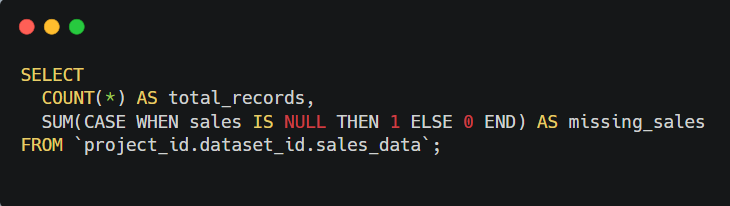
Query to validate data quality:
Model Training
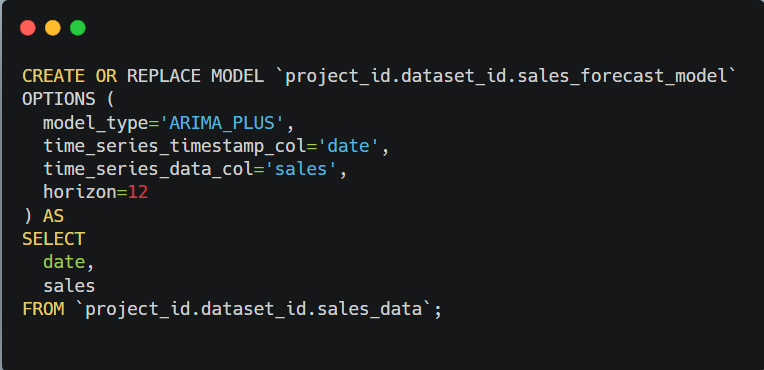
Use the ARIMA_PLUS model. This model supports time series forecasting. The following query creates and trains the model:
Evaluate Model Performance
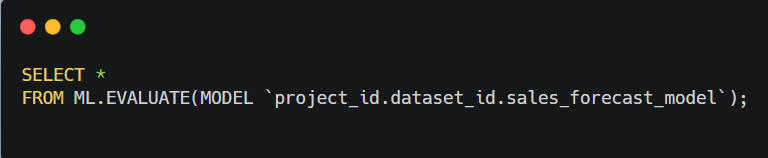
Validate model accuracy using RMSE and MAE. Engineers execute the following query:
4. Generate Sales Forecasts
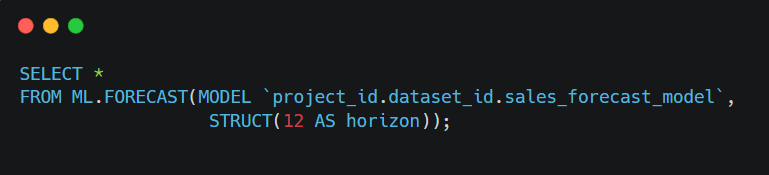
Predict sales for the next 12 months or a custom period:
5. Automate Deployment
Use Cloud Scheduler and Cloud Functions to automate model retraining. Configure periodic jobs to refresh predictions with current data.
6. Visualization
Export predictions to Looker Studio. Integrate directly into frontend applications via BigQuery APIs for real-time reporting.

Use Cases
- Demand Forecasting: Predict seasonal product demand from sales trends. Automate reordering to prevent stockouts.
- Dynamic Pricing: Forecast demand fluctuations. Enable real-time pricing adjustments for e-commerce platforms.
- Regional Sales Planning: Create region-specific models to set sales targets and allocate marketing budgets.
- Financial Planning: Generate accurate revenue forecasts for quarterly reports using historical and external data.
- Campaign Impact Analysis: Measure ad campaign ROI by comparing forecasts with and without campaign data.
Conclusion
BigQuery ML enables engineers to build robust sales forecasting models inside the data warehouse. This approach uses SQL for simplicity and scalability. BQML addresses key challenges, including demand prediction, dynamic pricing, and budget planning. These models provide insights for decision-making. For engineers, BigQuery ML serves as a practical tool that connects data analysis with machine learning.