
AI drives business operations, decision-making, and customer engagement. Increased AI capability raises scrutiny on development, training, and deployment. Regulators require complex answers. Boards demand strong assurance. Customers expect transparency.
AI Applications use generative AI services to build search, personalization, and conversational interfaces.
Google Cloud states that AI Applications do not use customer data to train foundation models. These models remain fixed. They process input to generate output only.
Data regulation non-compliance can cost businesses up to $15 million per year. The European Union AI Act imposes fines of up to 7% of global turnover for violations.
How do you build AI that works and earns trust? Data governance is the answer. If you understand the process but need expert execution, we can help.
Contact us
Governance as the foundation of trustworthy AI
Data drives every AI system. Collection, labeling, storage, and usage define model behavior. Weak governance creates opaque models and legal risk.
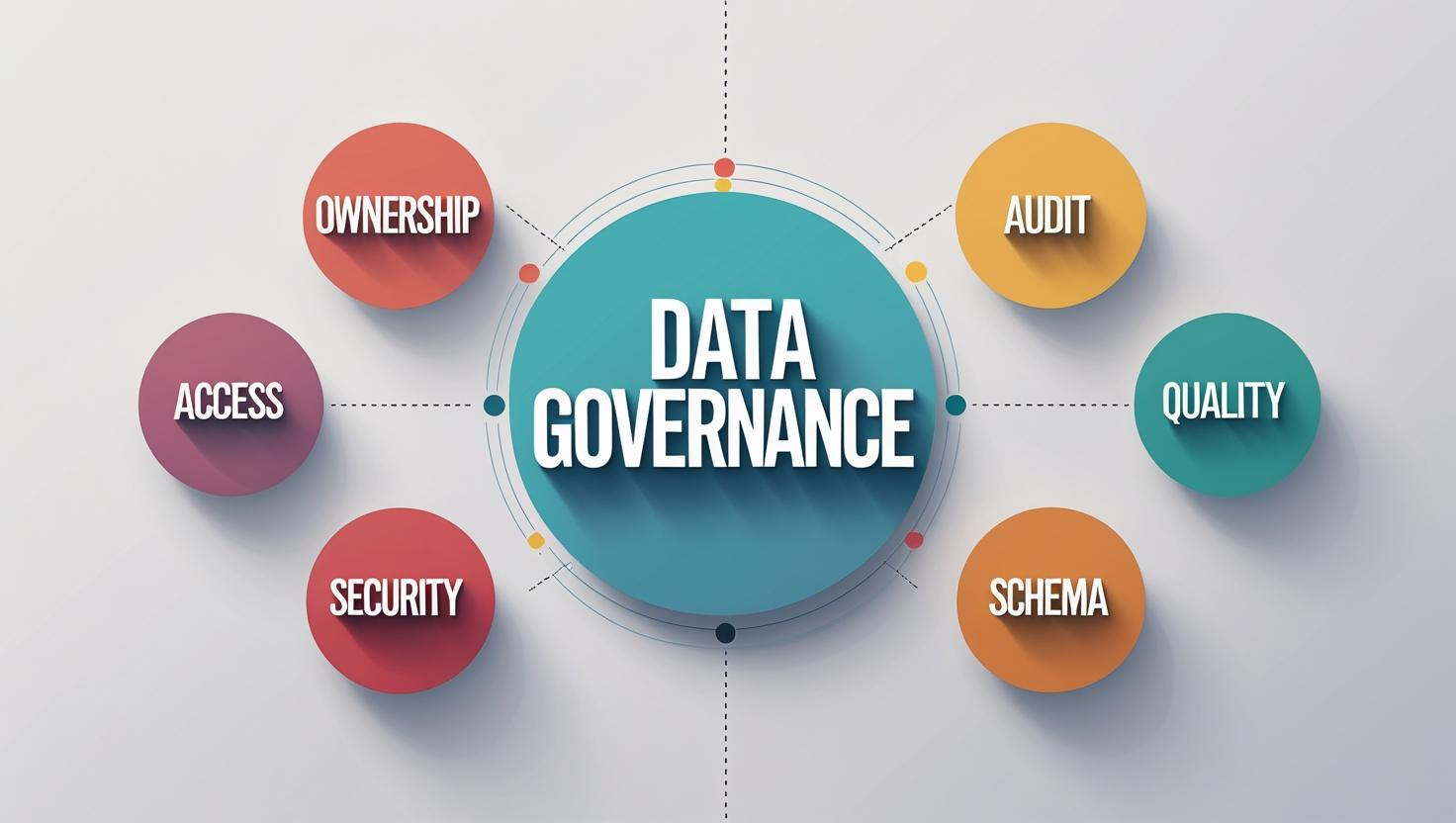
Governance structures data management. It defines ownership, usage, and security controls. These measures prevent bias, misuse, and drift. Governance also supports compliance with regulations such as GDPR and HIPAA.
Healthcare requires AI data governance for patient records, medical images, and diagnostic data. This ensures collection, labeling, storage, and access comply with HIPAA. Governance enforces access controls, audit trails, and data lineage tracking. These actions maintain trust and prevent misuse. Finance applies governance frameworks to manage customer data under GDPR and PCI DSS. This ensures AI models for fraud detection, credit scoring, and risk analysis use compliant, unbiased, and secure data. This approach reduces regulatory risk and protects customer trust.
Google Dataplex provides a Universal Catalog. It centrally discovers, manages, and governs data and AI artifacts across the data platform.
It delivers AI-powered governance through integration with Vertex AI. This enables unified search, metadata enrichment, and trust across datasets, models, and features.
Dataplex supports open lakehouses. It ensures secure, compliant, and scalable access to trusted data for analytics and AI.
Data Governance Framework: Operational Standards for Trustworthy AI
The following framework outlines methods to operationalize trustworthy AI through structured data governance.

Define project purpose.
State the objective and expected impact for each AI project. Identify the specific problem, beneficiaries, and affected parties. Record this information at initiation to ensure internal accountability and external transparency.
Manage data as a regulated asset.
Govern data with the same control as financial assets. Apply metadata tagging, lineage tracking, and access controls at all stages. Define policies that specify which data supports training, the conditions for use, and the retention period.
Integrate fairness and bias detection.
AI models amplify bias. Audit training datasets for representation gaps. Set thresholds for fairness metrics. Use explainability tools so non-technical stakeholders can interpret model outputs.
Assign roles and responsibilities.
Assign ownership for model performance. Assign owners for flagged issues and compliance violations. Create cross-functional governance councils that include data scientists and staff from legal, risk, and ethics teams.
Maintain Audit-Ready Documentation
Regulators and boards require evidence, not assurances. Maintain version-controlled records of training data, modeling decisions, testing results, and risk assessments. Automate documentation processes to reduce manual effort and ensure consistency.
Adapt Governance to Regulatory Changes
Governance requires continuous updates, not one-time implementation. Align frameworks with current legal requirements. Design flexible structures that adapt to new AI regulations across different markets.
SquareShift embeds responsible data governance into every stage of the AI development lifecycle. This approach ensures transparency, fairness, and compliance with current best practices.
SquareShift implements standardized AI-native governance, proactive policy enforcement, and role-based personalization as foundational pillars.
Trust is a competitive advantage.

AI innovation and responsible governance operate together. Organizations that invest in data governance build trust with users, boards, and society.
Trustworthy AI builds systems that people believe in. This approach maintains business resilience. Build trusted, compliant AI on Google Cloud. For help moving AI workloads to Google Cloud, see our Google Cloud migration services. Contact SquareShift experts to start a governance-first migration.
Contact SquareShift experts
Related reading: how to migrate a database to GCP and analytics platform migration case study.