
The initial plan specified a four-week performance campaign.
The media team approved creative assets and budgets. Ads launched on Google and Meta. Operations proceeded until Week 3. Then, the campaign paused.
Why did this happen?
Finance reported a different value.
The finance report showed budget consumption at 90%. The marketing dashboard showed consumption at 52%. Spend attribution differed between the two systems. Neither team could verify the correct figure.
The campaign paused for two days. Performance declined. Both teams attributed the error to the other. This scenario illustrates the operational impact of disconnected BI tools and inconsistent data logic. The impact extends beyond campaign efficiency.
It reduces inter-departmental trust.
Operational Impact of Unaligned BI Tools in Marketing and Finance
Marketing and finance share one goal: growth.
The teams approach this goal differently.
- Marketing requires speed, experimentation, and cross-channel visibility.
- Finance requires precision, traceability, and spend control.
This divergence is not a problem. The problem is when dashboards disagree and no one can identify the cause.
Financial services clients show this pattern:
- Marketing defines campaign cost metrics using marketing automation data (GA4, HubSpot, campaign managers).
- Finance extracts data from ERP systems or cost-center allocations in Snowflake or SQL ledgers.
- Dashboards embed attribution logic in Tableau or Excel.
- Data lacks a shared model, documentation, or reconciliation.
Finance challenges a cost line item. Marketing defends a CAC figure. Both positions contain valid elements. Neither is fully accurate. The discrepancy stems from divergent data views of the same customer journey. The tooling environment often magnifies this misalignment.
Why Looker Enables Marketing and Finance Collaboration
Looker addresses the root cause. It enforces shared data definitions at the backend. This mechanism serves as the core infrastructure for marketing and finance collaboration in BI environments.
Standardized Definition of Marketing Spend
Looker defines the calculation for “Marketing Spend” once in LookML. This definition applies to all interfaces. Finance views the metric in internal ledger dashboards. Marketing views it in campaign overviews. Both views rely on identical logic, data sources, and timestamps.
Real-Time Data Access for Finance and Marketing
Looker operates on BigQuery. Both teams query identical live data. Finance updates reflect in marketing reports immediately. Real-time collaboration requires a BI stack that maintains operational truth.
Role-Based Access Control for Cross-Functional Trust
Grant finance access to cost centers while restricting campaign creatives. Allow marketing to view spend pacing while masking salary allocations. Looker provides granular permissions that maintain security without limiting insight sharing.
Application of BI Tools for Marketing and Finance Collaboration
Marketing and Finance identified a cost discrepancy. One client, a digital bank, ran a student loan campaign. Marketing viewed the results favorably. Finance reported costs 40% higher. The cause was missing fees and naming inconsistencies. The team paused the campaign twice.
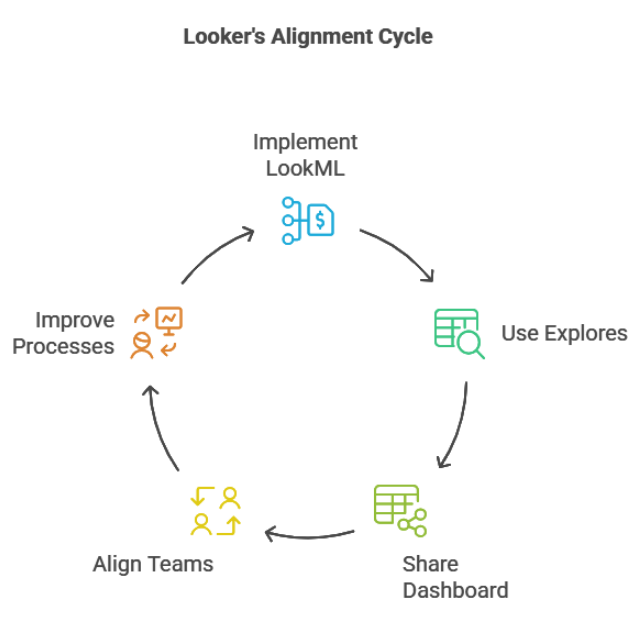
Looker unified the data:
- LookML: One cost model including all fees.
- Explores: Finance views by cost center. Marketing views by campaign. Both use the same logic.
- Shared Dashboard: Real-time pacing, burn, and forecast.
Looker aligned the teams. Finance pre-cleared budgets weekly. Marketing launched campaigns faster. Approval times dropped from days to hours. Teams shared Looker links instead of screenshots. The campaign returned to its original schedule. Both teams used the same data definitions.
Looker governs data definition, queries, sharing, and interpretation across departments. It does more than visualize data.
CFOs adopt Looker for control. CMOs trust it for accuracy.
The value lies in speed and clarity. Campaigns launch faster. Approvals move quicker. Misunderstandings decrease. Do you need to align Finance and Marketing?
We help CMOs migrate from Tableau to Looker. We preserve context and speed. We avoid redundant work.
Book a free consultation to resolve analyst-finance collaboration gaps.
.
Related reading: real-time marketing analytics with Looker, and the unified BI stack for financial services CMOs.
Consult a migration expert