
This document covers Google Vertex AI and BigQuery capabilities for text sentiment analysis. It details environment setup, data loading, analysis, and visualization. It also reviews BigQuery ML logistic regression and the role of sentiment analysis in customer relationships and strategy.
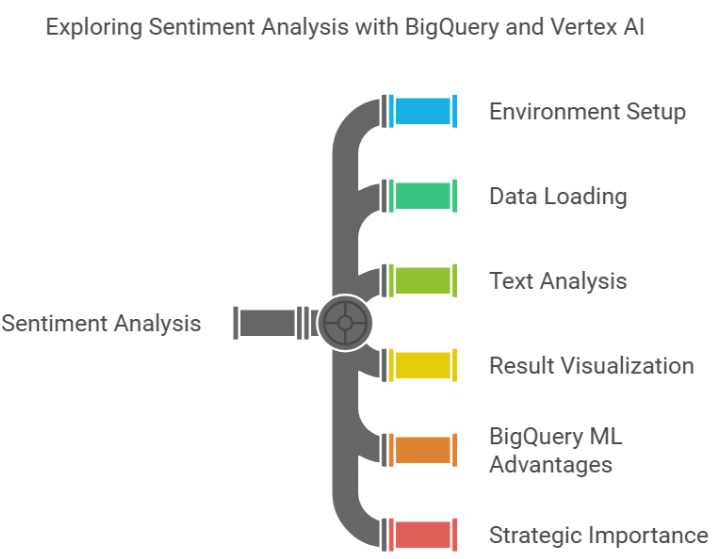
BigQuery Sentiment Analysis Workflow
Configure Environment
- Enable required GCP APIs and link billing accounts.
- Create a cloud resource connection in BigQuery.
Load data
- Import datasets, such as rideshare customer reviews, into BigQuery using LOAD DATA OVERWRITE or similar commands.
Create remote model
Run the CREATE OR REPLACE MODEL SQL statement to link a remote Vertex AI model to BigQuery.
Sentiment Analysis Use Cases
1. Retail Brand Customer Sentiment Analysis
Use Case: A retail company applies sentiment analysis to online reviews and social media posts to measure brand perception.
Scenario: A clothing retailer links Vertex AI and BigQuery to analyze sentiment in e-commerce reviews and social media posts.
Procedure
- Collect customer reviews and social media posts for the target brand.
- Load the data into BigQuery.
- Analyze sentiment (positive, neutral, or negative) using ML.GENERATE_TEXT.
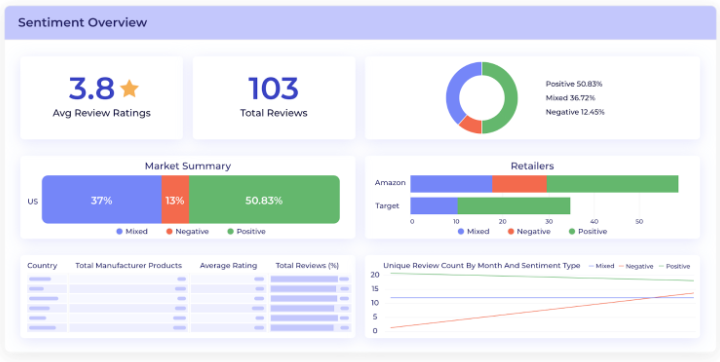
Create visualizations in BigQuery Data Canvas. Options include sentiment over time and sentiment by product category.
Result: The retailer identifies product issues and updates customer service and marketing strategies.
2. Detect Fraud in Financial Services
Use case: A bank analyzes customer support and flagged communication text to detect fraud.
Scenario: A financial institution uses BigQuery and Vertex AI to classify customer communication as suspicious or legitimate based on tone and sentiment.
Steps:
- Ingest customer emails, chat logs, and flagged interactions.
- Load the data into BigQuery.
- Use ML.GENERATE_TEXT to classify sentiment and detect anomalies in distress or urgency.
Visualize the results. Flag suspicious interactions for review.
The bank identifies fraud patterns and takes timely action.
3. E-Commerce Product Review Analysis
Use Case: An e-commerce company analyzes product reviews to identify customer satisfaction and dissatisfaction trends, then adjusts product offerings.
Scenario: An online retailer combines BigQuery and Vertex AI to process thousands of product reviews, isolating recurring issues and valued features.
Steps:
- Load product review data into BigQuery.
- Use ML.GENERATE_TEXT to extract themes and classify sentiment.
- Visualize data to track sentiment trends by product category or feature.
The retailer acts on specific feedback. For example, the team redesigns a product to improve usability or quality.
4. Public Opinion Analysis for Government Agencies
Government agencies analyze tweets and news articles. This process monitors public opinion on policy changes.
A government agency uses Vertex AI and BigQuery to analyze social media and news data. This process measures public sentiment toward a new health policy.
Process Steps
- Collect tweets and news articles on the health policy.
- Load the data into BigQuery.
- Run ML.GENERATE_TEXT to classify policy sentiment.
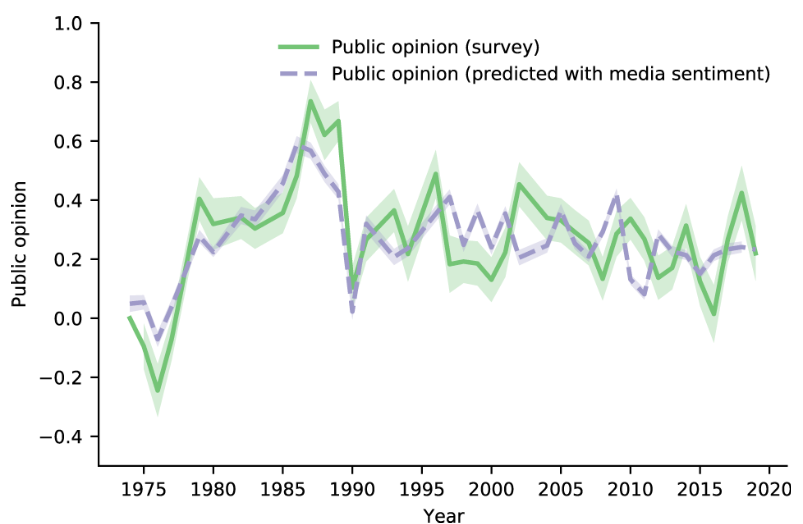
- Track sentiment shifts as events unfold.
Outcome: Real-time sentiment data enables rapid response to public concerns.
Benefits of BigQuery ML and Vertex AI
- SQL integration: Models run directly on BigQuery tables. No data export or import required.
- Scalability: Processes large datasets efficiently.
- Ease of Use: Executes machine learning tasks via SQL. Removes the need for complex code.
- Actionable Insights: Identifies data patterns. Supports strategic decision-making.
Conclusion: Rationale for Using BigQuery in Sentiment Analysis
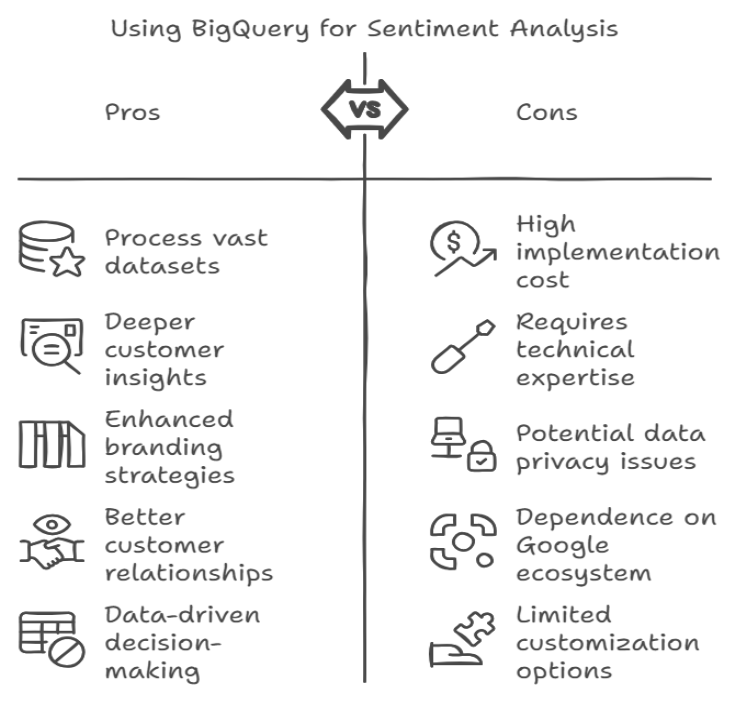
Sentiment analysis and brand monitoring are critical for market competitiveness. BigQuery enables the processing of large datasets. This capability yields deeper customer insights. It supports the enhancement of branding strategies. The integration improves customer relationships. It drives data-informed decision-making.
Future Considerations
Integrate real-time data processing and machine learning for sentiment analysis. This approach tracks changing consumer sentiment. It strengthens brand reputation. It supports long-term success in a competitive market. Related guides: fraud detection and risk management with BigQuery ML and a Vertex AI development environment with Vertex AI Pipelines.