
Businesses must detect fraud and manage risk to prevent financial loss and reputational damage. This guide details how to use Google BigQuery ML to build detection systems. Organizations can analyze large datasets in real-time. This approach improves the speed of fraud identification and risk mitigation. In short, BigQuery ML lets teams build fraud detection models with SQL: collect and preprocess transaction data, train and evaluate a model, then deploy it for real-time detection.
Introduction
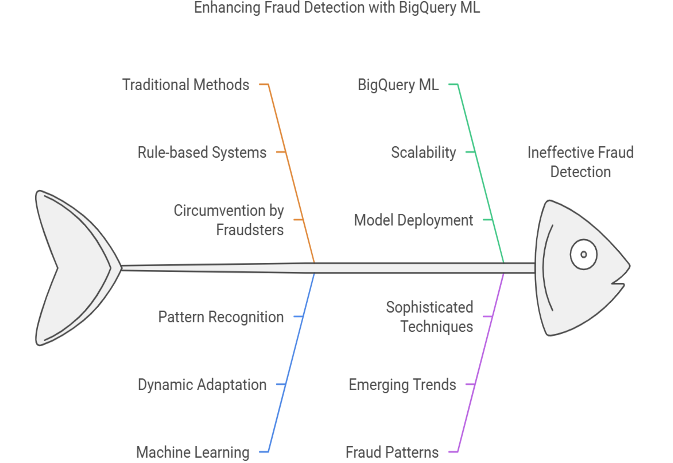
Fraud detection protects businesses in finance, e-commerce, and insurance. Traditional rule-based systems struggle with complex fraud tactics. Machine learning offers adaptive solutions. These models evolve with new fraud patterns. Google BigQuery ML creates machine learning models at scale. This platform enhances detection accuracy and strengthens risk management.
What Is BigQuery ML?
BigQuery ML lets teams build machine learning models using SQL. Key features:
- Simplicity: Build models with SQL skills. No advanced programming expertise required.
- Scalability: Process large datasets using serverless architecture.
- Integration: Link with other Google Cloud tools for data processing.
BigQuery ML provides a scalable solution for fraud detection and risk management in data-driven environments.
Implementation of BigQuery ML for Fraud Detection
Fraud detection using BigQuery ML requires the following steps:
Data Collection - Acquire transaction records, including amount, location, timestamp, and user behavior.
Data Preprocessing - Prepare the dataset by:
Select algorithms suited to fraud detection, such as logistic regression, decision trees, or neural networks.
Train models using historical transaction data to identify patterns of fraud.
Evaluate performance using precision, recall, and F1 scores to confirm reliable fraud detection.
Deploy trained models for real-time detection to enable rapid response to suspicious activity.
- Remove missing or inconsistent data entries.
- Normalize numerical data to ensure uniform scale.
- Encode categorical data for model compatibility.
Risk Management Strategies Using BigQuery ML
Fraud detection is necessary but not sufficient. Effective risk management requires:
- Set Thresholds: Define transaction limits to flag unusual activity for review.
- Continuous Monitoring - Monitor data streams in real time - Detect fraud attempts immediately - Execute response actions
- Feedback Loops - Review past fraud investigations - Extract insights from cases - Update models to increase accuracy
Conclusion
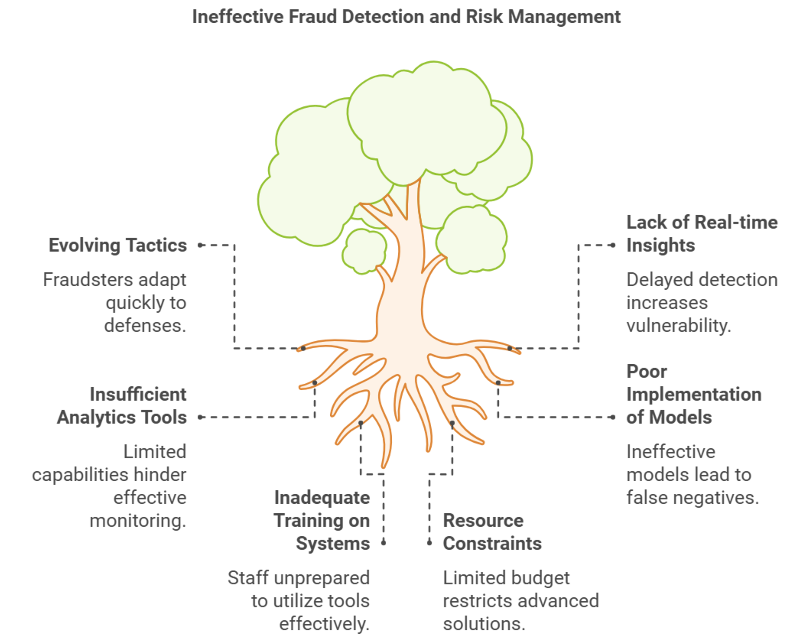
Fraud detection protects financial assets and reputation. BigQuery ML enables real-time data analysis. It supports fraud identification and risk mitigation. As fraud tactics change, advanced analytics become critical. SquareShift AI supports this work. See: AI-Powered Vulnerability Management: Transform Your Security Operations, Cut Response Time by 75%
For more information:
Contact Us
For help building models like this, see our data engineering services.
Related reading: predicting customer churn with BigQuery ML and BigQuery ML pipelines with MLflow.