
Personalized product recommendations drive customer engagement and sales. Google Cloud BigQuery ML enables teams to build scalable recommendation systems within existing data warehouses. This article details how to use BigQuery ML to optimize product recommendations for e-commerce platforms.
SquareShift data engineers build and scale BigQuery recommendation systems.

Why Product Recommendations Matter for E-Commerce
Product recommendations drive e-commerce growth. Models analyze customer behavior, purchase history, and preferences. This process suggests relevant items and drives the following outcomes:
- Increased conversion: Customized suggestions help customers find target items.
- Improved retention: Personalized experiences build customer loyalty.
- Higher average order value: Recommendations enable cross-selling and upselling.
Building recommendation systems requires significant resources. BigQuery ML simplifies this process.
Building a Recommendation System with BigQuery ML: A Step-by-Step Approach
Step 1: Prepare the Data
E-commerce platforms generate multiple data types, including:
- User Data: Demographics, browsing history, and preferences.
| user_id | age | gender | location | browsing_history |
|---|---|---|---|---|
| 101 | 25 | Female | New York, USA | ["electronics", "fashion"] |
| 102 | 32 | Male | London, UK | ["books", "gadgets"] |
| 103 | 39 | Female | Sydney, Australia | ["beauty", "home decor"] |
- Product Data: Descriptions, categories, and prices.
| product_id | category | price | description |
|---|---|---|---|
| 1001 | Electronics | 299.99 | "Noise-canceling headphones" |
| 1002 | Fashion | 49.99 | "Classic white t-shirt" |
| 1003 | Books | 19.99 | "Bestselling novel" |
- Interaction data: Clicks, views, purchases, and ratings.
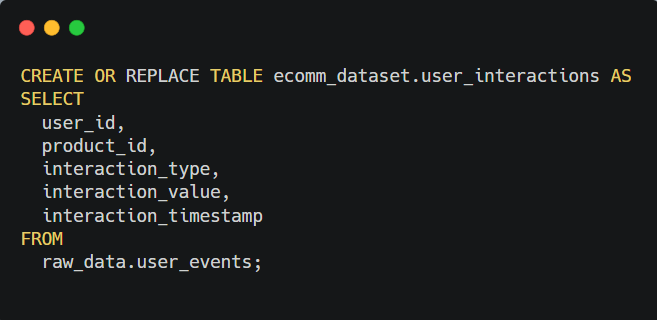
| user_id | product_id | interaction_type | interaction_value | interaction_timestamp |
|---|---|---|---|---|
| 101 | 1001 | Purchase | 5 | 2024-12-01 10:30:00 |
| 102 | 1003 | View | 1 | 2024-12-02 14:00:00 |
| 103 | 1002 | Purchase | 4 | 2024-12-03 18:45:00 |
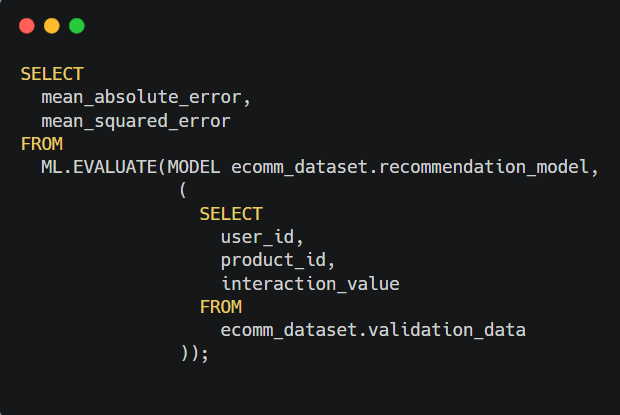
- Validation data table: Contains a subset of interactions to evaluate model accuracy.
| user_id | product_id | interaction_value |
|---|---|---|
| 101 | 1002 | 4 |
| 102 | 1001 | 5 |
| 103 | 1003 | 3 |
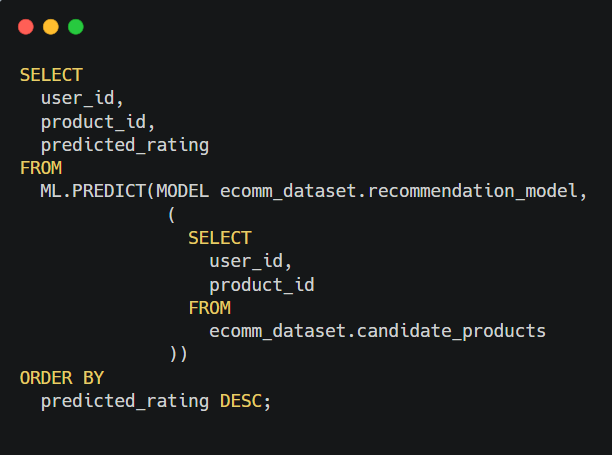
- Candidate products table: Lists products eligible for user recommendations.
| user_id | product_id |
|---|---|
| 101 | 1003 |
| 102 | 1002 |
| 103 | 1001 |
- Recommendation predictions table: Stores prediction results from the recommendation model.
| user_id | product_id | predicted_rating |
|---|---|---|
| 101 | 1003 | 4.8 |
| 102 | 1002 | 4.5 |
| 103 | 1001 | 4.7 |
Clean and normalize data. Store data in BigQuery tables. Create a user interaction table:
2. Select the BigQuery ML Recommendation Model
BigQuery ML provides the following models for recommendations:
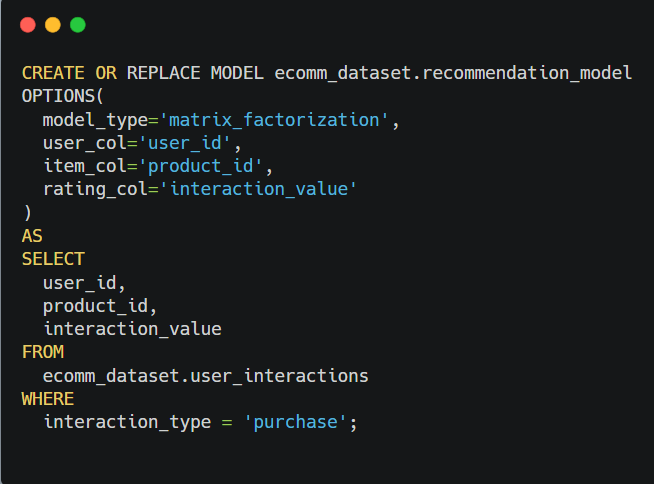
- Matrix Factorization: Collaborative filtering.
- K-means Clustering: Segment users or products.
- Linear and Logistic Regression: Specific prediction tasks.
Train a matrix factorization model for collaborative filtering using the CREATE MODEL syntax.
3. Evaluate the model
Assess model performance using Mean Absolute Error (MAE) or Root Mean Square Error (RMSE).
Adjust model parameters or input features to improve performance.
4. Generate predictions
Query the trained model to generate product recommendations for users.
Integrate these predictions into the e-commerce platform recommendation engine.
5. Monitor and Update the Model
Retrain the model with fresh data to maintain relevance. Automate retraining and evaluation workflows using Cloud Composer or Vertex AI.
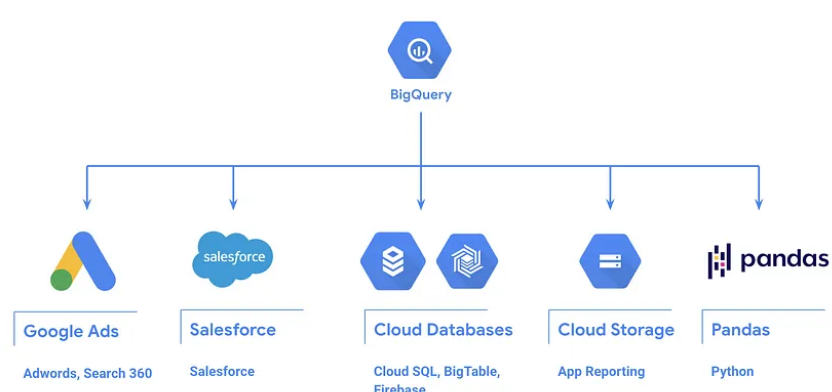
BigQuery ML Use Cases in E-commerce
- Personalized Product Recommendations: Suggest items based on user browsing and purchase history.
- Dynamic Pricing Models: Set prices based on customer behavior and market trends.
- Customer Segmentation: Group customers into clusters for targeted marketing.
- Inventory Management: Predict product demand to optimize stock levels.
- Churn Prediction: Identify at-risk customers to apply retention strategies.
- Cross-selling and upselling. Recommend complementary or premium products. This increases average order value (AOV).
Conclusion
BigQuery ML optimizes product recommendations for e-commerce. It enables personalized shopping experiences and simplifies machine learning workflows. The SQL-based interface and scalable architecture integrate with the Google Cloud ecosystem. This makes advanced recommendation systems accessible to all business sizes. E-commerce markets are evolving. Adopting these tools supports competitive positioning.