
Customer churn reduces revenue in competitive markets. Retaining existing customers is less costly than acquiring new ones. Accurate churn prediction supports long-term growth. Google BigQuery ML provides a scalable platform to model churn and define retention actions.
This article explains how BigQuery ML streamlines churn prediction. It outlines strategies to maintain customer engagement and loyalty.

BigQuery ML for Customer Churn Prediction: Key Advantages
BigQuery ML creates machine learning models inside Google BigQuery. It removes data export requirements.
- Reduced Complexity: No external environments or complex setups required.
- Scalability: Processes millions of customer data points.
- SQL Integration: Uses standard SQL queries for model creation. No advanced programming skills required.
Predict Customer Churn With BigQuery ML
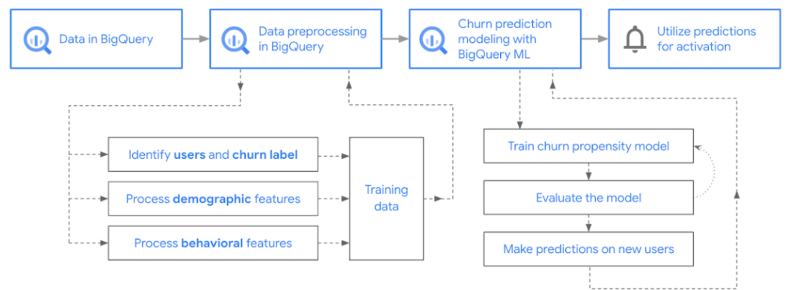
- Data Preparation. Consolidate historical customer data. Sources include transaction history, engagement metrics, support interactions, and demographic information. Clean the data. Handle missing values. Normalize numerical fields. Encode categorical variables.
- Feature Engineering. Identify key churn predictors. Examples include reduced activity, declining purchase frequency, and negative feedback. Create derived features. Calculate lifetime value (LTV). Compute recency, frequency, and monetary (RFM) metrics.
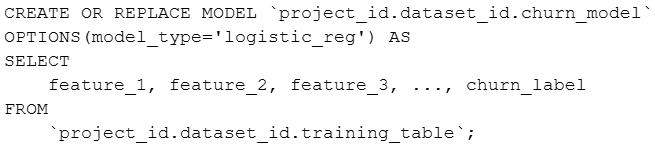
Model Training.
Build a logistic regression model in BigQuery ML for churn prediction. For example:
Train the model with historical data that includes labeled churn outcomes.
Model Evaluation
Validate model performance using AUC-ROC, precision, recall, and accuracy. Use the BigQuery ML built-in evaluation functions.
Prediction
Predict churn probabilities for current customers. Flag high-probability cases for immediate retention actions.


Create a GCP Notebook Instance for BigQuery ML
Retention Actions From BigQuery ML Insights
- Targeted Marketing: Use churn predictions to segment customers. Send personalized offers to at-risk accounts.
- Enhanced Support: Prioritize at-risk customers. Use proactive engagement, such as follow-up calls or dedicated support teams.
- Product Improvements: Analyze churn drivers. Refine features, pricing, or service delivery.
- Loyalty Programs: Design reward systems for high-risk segments. Match programs to customer needs and preferences.
- Feedback Loops: Collect regular input from at-risk customers to resolve issues immediately.
Case Study: BigQuery ML Cuts Churn for a Subscription Business
A subscription service had a 25% annual churn rate. This caused significant revenue loss. The team added BigQuery ML to their data pipeline:
- Model Accuracy: The model identified at-risk customers with 85% accuracy.
- Improved Retention: Targeted campaigns cut churn by 15% over six months.
- Cost Savings: Optimize marketing spend by targeting at-risk customers only.
Conclusion
BigQuery ML provides tools to predict customer churn and execute retention strategies on a scalable platform. Organizations can use predictive insights to address churn and build long-term customer loyalty. Related BigQuery ML guides: demand forecasting with BigQuery ML, fraud detection and risk management with BigQuery ML and e-commerce recommendations with BigQuery ML.
Reduce Churn with BigQuery ML
Implement retention strategies using BigQuery ML analytics and machine learning.