
Legal professionals manage large volumes of case law for trials and research. Historical judgments range from 50 to 500 pages. These documents contain key insights and precedents. Manual review is slow, labor-intensive, and prone to error. Legal teams need automated summarization. This approach allows professionals to focus on high-value tasks.

This article details a solution using TensorFlow and Google Cloud. We examine the technical architecture for automated legal document summarization. We highlight how natural language processing (NLP) addresses specific research challenges.
Problem: Manual Legal Research Is Slow and Error-Prone
Legal research is a core function of legal practice. Lawyers, judges, and legal researchers review case files, judgments, and statutes to identify relevant information. This process is often inefficient, particularly when handling large volumes of court judgments and verdicts.
Manually reviewing hundreds of pages to extract key points, such as judgments, precedents, and legal arguments, causes the following issues:
- Inconsistent analysis: Legal documents are complex. Extracting key information requires subjective interpretation. Different professionals may focus on different aspects of the document. This leads to inconsistent results.
- Time inefficiency: Legal professionals spend hours or days reviewing lengthy documents. This time could be used for higher-value activities, such as case strategy or legal counseling.
- Missed insights: Manual review may overlook key precedents and rulings. This affects the accuracy and quality of legal decisions.
Organizations require an automated solution to summarize legal documents while preserving critical details.
Automate Legal Document Summarization Using TensorFlow and Google Cloud
We built a Legal Document Summarization Application using TensorFlow and Google Cloud services. The system processes large volumes of legal text and generates concise summaries containing critical information. The workflow consists of these steps:
Architecture Components
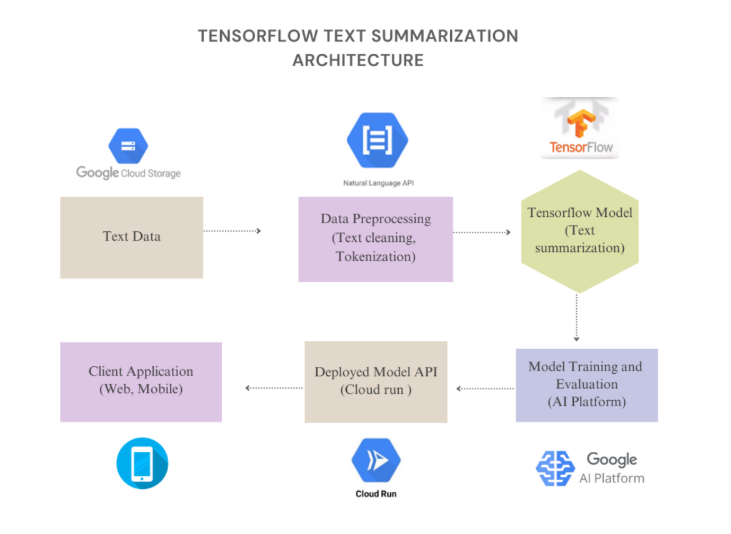
Upload and Preprocess Documents:
Users upload PDFs, Word files, and scanned images via the web interface. The system stores these documents in Google Cloud Storage (GCS). The Google Cloud Vision API performs Optical Character Recognition (OCR) on scanned documents. It converts image-based text into machine-readable format. For text-based documents, such as PDFs, the Google Cloud Natural Language API parses the content. It extracts named entities, sentences, and paragraphs for summarization.
TensorFlow Summarization Pipeline
The system extracts and preprocesses the text. TensorFlow summarizes the document. The solution uses a custom Natural Language Processing (NLP) pipeline. This pipeline trains specifically on legal language. The pipeline includes several layers:
The pipeline uses Natural Language Processing (NLP) and Large Language Model (LLM) architectures. The system fine-tunes these models on large legal datasets. This process improves understanding of legal terminology and context. The system generates high-quality, domain-specific summaries.
The solution runs TensorFlow models on Google Compute Engine (GCE). GCE provides the computational power required for the models. This includes Graphics Processing Units (GPUs) to process large data volumes efficiently. The system allocates resources dynamically based on load. This allows the summarization pipeline to scale with document volume.
Real-time Summary Generation
- The model generates a concise summary immediately after document processing.
- The system stores the output in Google Cloud Storage.
- The web interface displays the summary to the user.
Feedback Loop and Model Refinement
- Legal professionals provide feedback on generated summaries.
- Feedback verifies output accuracy and identifies improvement areas.
- The system uses this data to retrain models periodically.
- This process adapts the model to new legal language and case types.
Security and Compliance
- The solution applies strict security standards to handle sensitive data.
- Google Cloud IAM controls document access.
- Only authorized personnel can view or modify data.
- The system encrypts data at rest and in transit using Google Cloud features.
- TLS secures all communications.
- The solution complies with GDPR and CCPA regulations.
- Text Tokenization - The system splits document text into smaller units. - These units are words or phrases. - This step enables effective text processing.
- Contextual Embedding - The system uses pre-trained NLP models, such as BERT or other transformer architectures. - These models convert text into high-dimensional vectors. - The vectors capture contextual meaning.
- Summarization: The model condenses legal text. It extracts key details, such as precedents, judgments, and case arguments.
Solution Benefits
- Efficiency: The tool generates concise summaries rapidly. It reduces processing time for lengthy documents. Professionals can allocate time to strategic tasks.
- Accuracy: TensorFlow-based NLP models capture critical details consistently. This approach minimizes human error across all documents.
- Scalability: Google Cloud infrastructure supports scaling. The system processes increasing document volumes without performance degradation.
- Real-Time Processing: The system generates summaries instantly. Users access required data quickly.
- Continuous Improvement: A feedback loop improves system accuracy. The system adapts to new legal contexts over time.
Conclusion
The Legal Document Summarization Application, built with TensorFlow and Google Cloud, transforms legal workflows. Automation reduces the time and effort for legal research. The solution improves consistency. It ensures key legal insights are not missed.
This solution shows how AI and cloud computing solve real-world problems. It streamlines operations in sectors that require accuracy, speed, and scalability, such as law.
AI will drive legal workflow efficiency. This solution improves document analysis and supports better decision-making.
SquareShift offers AI implementation services for document-heavy workflows like this one.
For a related project, read the case study on turning court judgments into audio summaries, and our practical guide to LLM-powered applications.