
DevOps supports Elasticsearch, BI migrations, and cloud transformations.
Ransomware and library vulnerabilities, such as Log4J, make security a priority. This series covers DevSecOps. We examine Open Source and commercial tools.
Part 1 covers DevSecOps history and impact on the software lifecycle. Read this blog to learn how AI transforms security.
Definition of DevSecOps
DevSecOps combines Development, Security, and Operations. It secures application and infrastructure in every phase of the Software Development Life Cycle (SDLC). DevSecOps shifts the security model. It assigns security accountability to all team members. It ensures consistent security execution.
Shift left defines a core DevSecOps principle. Engineers move security checks from the end to the start of the DevOps process. In this environment, security becomes integral from the initial stage.
DevSecOps treats security as a shared responsibility. Every SDLC participant plays a role in building secure CI/CD workflows. Organizations integrate security into all life cycle stages. These stages include inception, design, build, test, release, support, and maintenance.
DevSecOps integrates security into continuous integration, continuous delivery, and continuous deployment pipelines. It embeds security values into software processes. This makes security verification an active and integrated part of development.
Role of DevSecOps
- DevSecOps allocates security responsibilities across the software lifecycle. It covers design, development, testing, deployment, and maintenance.
- DevSecOps establishes a shared accountability model. All team members own security outcomes.
- DevSecOps embeds security checks into Agile and DevOps workflows. Security becomes a native feature, not a final step.
- Traditional methods delay delivery. Security flaws discovered late increase time and cost. DevSecOps prevents these delays. It reduces rework and lowers remediation expenses.
- Review, audit, scan, and test code for security issues in every phase of the cycle. Fix issues immediately upon detection. Apply controls before adding new dependencies. Early integration reduces the cost of remediation.
DevSecOps Phases
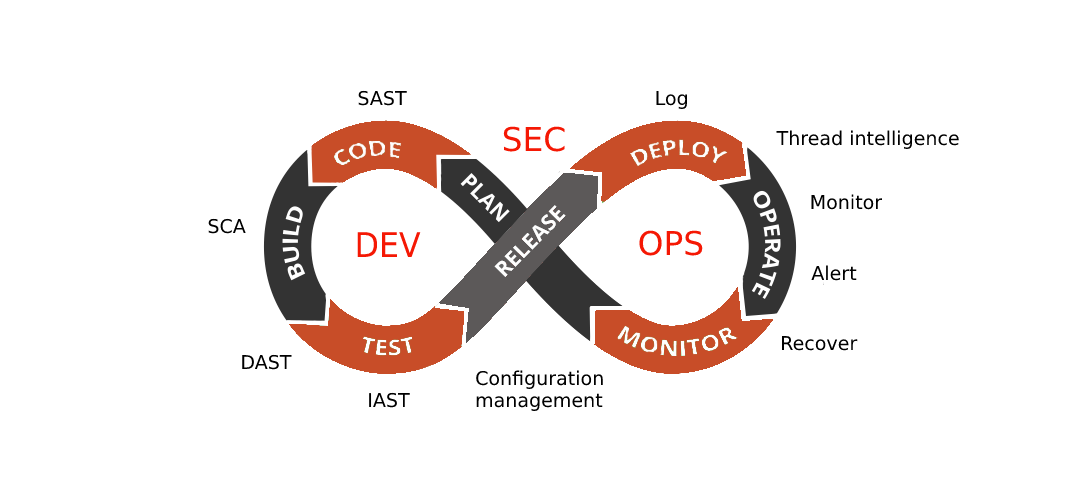
Add security checks to each phase of the DevOps pipeline. Include plan, code, build, test, release, deploy, and maintenance.
Plan
Plan, discuss, review, and analyze security in the first phase. List all development lifecycle phases. Define security testing methods for each phase. Set the schedule and execution method for these tests.
Code
This phase enables developers to write secure code. DevSecOps tools review and analyze code for each commit and pull request. The core process is Static Application Software Testing (SAST) of the source code.
The system scans code for security vulnerabilities, including auth key detection, bug detection, code flaws, and breaches. This allows developers to identify security issues during development. Early detection fixes issues quickly. This improves application reliability and reduces remediation costs. Security checks occur at multiple stages:
- Code writing
- Code commit
- Code merge to the target branch
The system rejects pull requests if source code contains security vulnerabilities.
Build
The build phase starts when developers push code to the repository. A key risk is security vulnerabilities in open source libraries. Modern applications use 60% to 80% open source libraries for business logic and requirements. Developers install and build upon third-party code dependencies and libraries. These sources may be unknown or untrusted. External dependencies may include vulnerabilities and exploits by accident or design.
Organizations must verify open source security for third-party dependencies during the build phase. Deploy a dedicated solution to track and alert users on open source risks across the DevSecOps pipeline.
Implement automated security analysis on build output artifacts. Apply Software Composition Analysis (SCA) and Static Application Security Testing (SAST). Tools resemble those in the code phase, but run in a sanitized build environment.
Test
The test phase begins after a build deploys to the testing environment. Conduct functional and end-to-end testing to verify software functionality and identify security gaps. DevSecOps integrates security checks into these tests to detect vulnerabilities and breaches.
The test phase includes two types:
IAST: Interactive Application Security Testing scans code for vulnerabilities during manual or automated testing. IAST identifies the specific code line causing security issues. IAST produces accurate results with low false positive rates. DAST: Dynamic Application Security Testing, also known as black box testing, detects flaws in live applications. DAST interacts with web applications and APIs as an external user. It performs security checks to identify known vulnerabilities.
Release
The release phase validates environment configurations to ensure infrastructure security. It checks secret data management, user access control, and network firewall access.
This phase applies the Principle of Least Privilege (PoLP) to secure configurations. PoLP states that users, programs, and processes receive only the privileges needed to complete tasks. Entities do not hold access rights they do not need. The release phase validates API keys and access tokens. This ensures they hold only required access. Without this phase, excessive access rights expose the system to higher security risks.
Deployment
The Deployment phase identifies configuration differences between production, staging, and development environments. Security test results from previous phases require validation and verification. Limits can stop deployment if results do not meet standards. Containerization simplifies deployment across multiple environments but introduces new vulnerability surfaces. This phase scans containers and images for security issues and reports findings.
Maintenance
Monitor application behavior after production deployment. Implement automated security checks to observe live applications for attacks or suspicious activities.
A dedicated team performs penetration testing to find vulnerabilities without compromising systems. Organizations may run bug bounty programs that pay external individuals for reporting security exploits. Establish a protocol to monitor incidents and capture sufficient information to identify root causes. Implement automated alerting systems to inform security teams of issues immediately.
Our next article examines each phase and the tools used in that space. If you are a DevOps expert interested in starting a career at SquareShift, contact us.