
Marketing teams believe they master customer segmentation.
Execution often lacks clarity.
Target specific segments with tailored offers. Personalize experiences. Execute with speed.
Current processes for segment insights require weeks to complete:
- Submit request to Analytics.
- Cross-check data with CRM.
- Review inconsistent spreadsheets from multiple teams.
- Resolve conflicting segment definitions.
By the time the report arrives
customer behavior has already changed.
This is not an anomaly. Most customer segmentation tools fail to track rapid customer shifts.
This section examines why segmentation fails and outlines actions for CMOs.
Why Customer Segmentation Remains Difficult
The cause is not lack of effort. The cause is that current tools and workflows do not fit modern needs:
Siloed systems. CRM, web analytics, and product usage data store different segment definitions.
- Batch updates. Segmentation runs occur monthly or quarterly. They do not run live.
- Manual processing. Analysts merge customer lists in Excel or Tableau.
- Rigid models. Segments rely on static attributes. They ignore dynamic behavior.
In financial services, compliance and data access constraints increase processing time.
Segmentation remains stalled.
Why is segmentation difficult?
The customer journey is dynamic. The tools remain static.
Consider the question: "We invested in Tableau. Can better dashboards resolve this?"
Dashboards do not resolve data agility constraints.
- Tableau uses data extracts. Segmentation data is often outdated.
- Merging behavioral and transactional data requires manual joins.
- New data cuts require custom views.
Dashboards provide clear visualizations.
However, real-time, flexible segmentation for personalization requires a different approach.
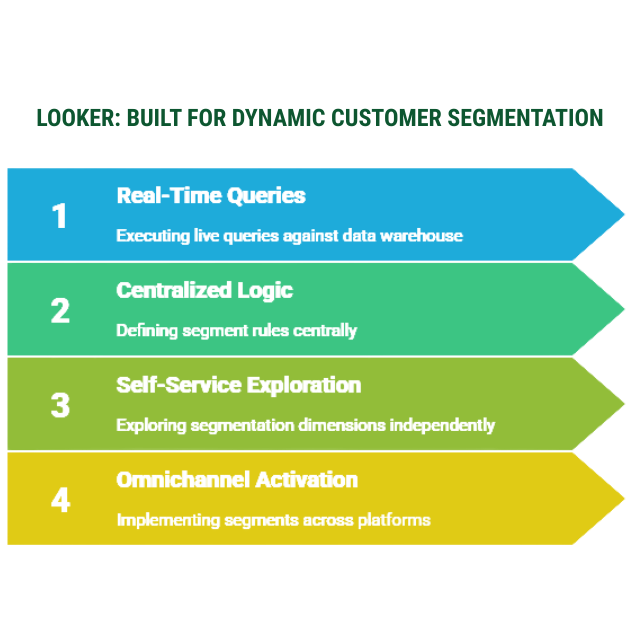
Looker addresses dynamic customer segmentation. 1. Real-Time Segmentation Queries
Looker removes the dependency on scheduled extracts.
It executes live queries directly against data warehouses, such as BigQuery.
Capabilities include:
- Extract segments from live behavior.
- Define dynamic cohorts (e.g., users who clicked within 48 hours but did not purchase).
- Modify filters in real time.
Result: Personalize campaigns while behaviors remain current.
2. Centralize Business Logic (LookML)
Looker's semantic layer (LookML) defines segment rules centrally.
- Eliminates ambiguity in definitions such as 'high value user.'
- Prevents duplication across teams.
Marketing, product, and CX teams use identical segments automatically.
3. Safe Self-Service Exploration
Marketing and CX teams can test segmentation dimensions without:
- Disrupting core metrics.
- Burdening analysts with ad hoc tasks.
- Delaying custom reports.
Result: Faster personalization. Greater team autonomy.
4. Omnichannel Activation
Send segments from Looker to ad platforms, email systems, and CRM workflows to engage users across all channels.
Impact: Deliver true 1:1 personalization using real-time data.
Related reading: customer segmentation with Looker and BigQuery and real-time marketing analytics with Looker.
An insurance provider we advised was limited to quarterly segmentation cycles.
- Analysts spent 3–4 weeks creating cohort reports.
- Teams used static segments.
- Personalization lacked precision.
Following the migration to Looker:
- Segmentation uses behavior data, not only demographics.
- The system refreshes data weekly.
- Campaign teams built segments in real time.
Outcomes:
- Email engagement rates increased by 19%.
- MQL to SQL conversion time decreased by 12%.
The team did not add dashboards.
They increased learning velocity. Contact SquareShift Looker migration experts for a consultation.
Contact Us