
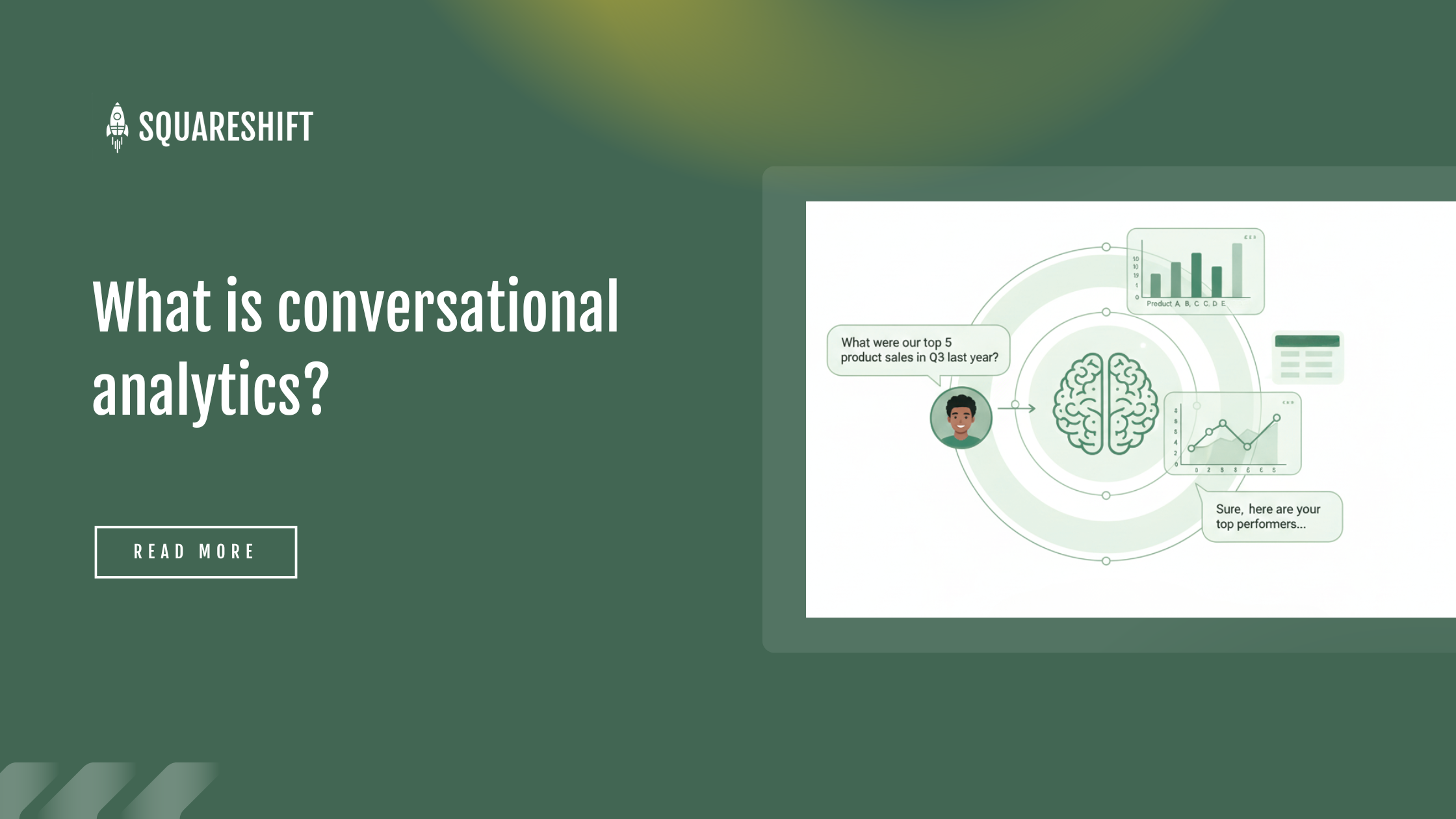
Conversational analytics allows users to query data via natural language. Users ask questions and receive direct answers. This method replaces dashboards and reports.
Conversational analytics simplifies data access for business users. It removes the need for technical skills. It uses trusted data models.
Users ask questions like “What were total sales last month?” The system provides immediate answers. This interaction mimics natural language inquiry.
Organizations increasingly link conversational analytics with AI-driven business intelligence.
Core components of conversational analytics
Conversational analytics combines natural language processing, structured data logic, and relational context management.
Natural language analytics enables systems to interpret user queries phrased in everyday language.
The semantic layer ensures consistent definitions of business terms, such as revenue, profit, or churn. This consistency supports self-service analytics at scale.
Query execution and context awareness enable users to ask follow-up questions without re-entering parameters.
Users ask: “What is revenue this quarter?” They follow up: “How does that compare to last quarter?” The system links both questions. This is a core feature of search-led analytics.
Read our complete guide to conversational analytics in Looker to see how this logic applies in a BI platform.
2. How conversational analytics works
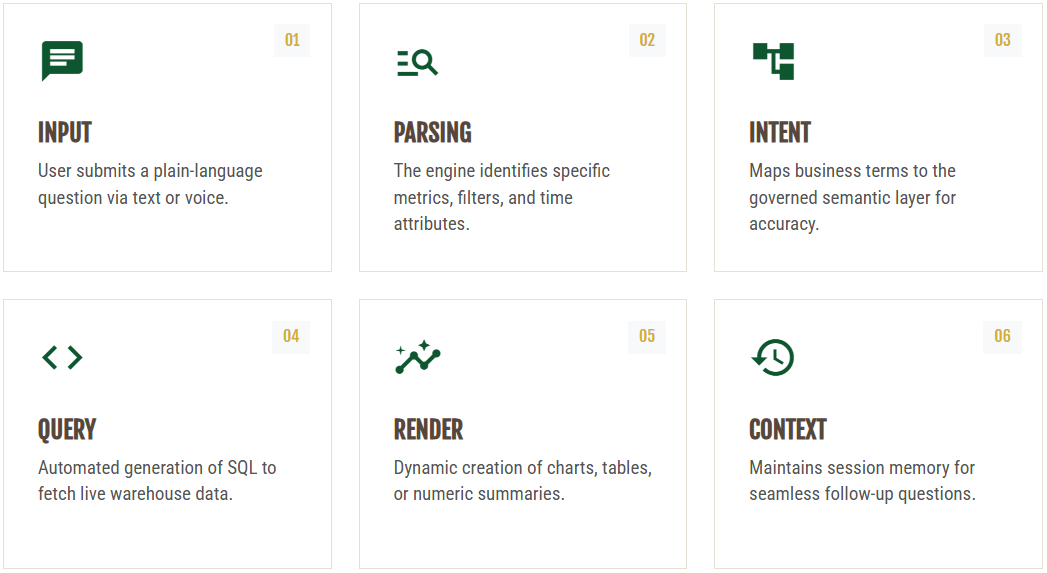
Conversational analytics runs on a repeatable workflow.
- Users ask questions. They type: “What were sales last month by region?” This is the simplest form of conversational BI.
- 1. Identify intent
- Parse natural language input.
- Extract key variables: metric, time range, and grouping.
- 2. Apply business logic
- The semantic layer maps terms to governed fields.
- Standard definitions ensure data consistency.
- This step enables reliable self-service analysis.
- 3. Execute query
- Convert request to a structured query.
- Run query on approved data sources.
- 4. Present results
- Display output as a number, table, or chart.
- Clear presentation supports immediate decision-making.
- 5. Maintain context
- Process follow-up questions within the same session.
- The system retains prior filters and parameters.
3. Business Value of Conversational Analytics
Conversational analytics accelerates and improves decision-making.
- It removes friction between users and data.
- Teams ask questions in plain language.
- The system provides immediate answers.
- This replaces manual dashboard navigation and report waits.
This approach enables self-service analytics while preserving governance. It serves as a practical layer of AI-driven business intelligence for enterprise use.
This change alters daily data usage patterns.

3.1 Faster Decision-Making
Data inaccessibility slows decision-making. Teams wait for dashboards, reports, or analyst support.
Conversational analytics allows managers to ask:
- “What changed in sales this week?”
- “Which region missed targets yesterday?”
The system provides immediate answers. Decisions occur in minutes, not days.
Wider data adoption across teams
Traditional BI tools serve analysts, not business users. Conversational analytics reduces entry barriers.
- Sales, marketing, finance, and operations teams access insights without technical skills.
- This expands data usage across the organization, not just within analytics teams.
Many organizations start this shift by migrating business intelligence systems to modernize their data stack.
Reduced dependency on analysts and reports
Business teams depend on analysts for routine queries. This limits throughput.
Conversational analytics automates routine queries:
- Performance validation
- Trend analysis
- Data segmentation
Analysts shift focus from repetitive reporting to deep analysis.
3.4 Real-Time Answers
Conversational analytics provides information symmetry in complex scenarios, such as high-stakes meetings. Leaders query live data to address risks or opportunities immediately. This practice maintains momentum and prevents delays caused by data access barriers.
4. Conclusion
Conversational analytics changes how organizations use information. It replaces static dashboards with a natural language interface. This shift makes data accessible to all decision-makers, from front-line staff to executive leadership.
See our Looker conversational analytics solution for how SquareShift delivers this, and read our comparison of top conversational analytics tools.
Q: What is the primary goal of conversational analytics?
It enables business users to query data using natural language instead of complex dashboards.
Q: How does the system handle follow-up questions?
Context awareness links consecutive questions within the same thread.
Q: How does the workflow begin?
The user enters a plain-language question, such as "Show sales figures by region."
Q: Can users access real-time answers during meetings?
Yes. SquareShift solutions provide live data access, allowing leaders to query metrics and address risks immediately.
Q: How does the system ensure accuracy?
A semantic layer maps natural language queries to governed business definitions.
Q: Can conversational analytics present data visually?
Yes. The system returns results as charts, tables, or numbers based on the query type.
Q: What is conversational analytics in simple terms?
Conversational analytics allows users to query data in natural language. Users ask questions, such as total sales last month, and receive direct answers. It removes the need for technical skills and uses trusted data models. This method replaces dashboards and reports for routine questions and simplifies data access for business users.
Q: What are the core components of conversational analytics?
Conversational analytics combines natural language processing, structured data logic and relational context management. A semantic layer keeps definitions of business terms, such as revenue, profit or churn, consistent. Query execution and context awareness let users ask follow-up questions without re-entering parameters. This supports self-service analytics at scale.
Q: How is conversational analytics different from a dashboard?
Traditional BI tools serve analysts, not business users. Conversational analytics replaces static dashboards with a natural language interface. Teams ask questions in plain language and get immediate answers, instead of waiting for reports or analyst support. The semantic layer still preserves governance. Decisions occur in minutes, not days.